When a child does not want to go to school, what might be happening?
It is common to hear parents say: “my child cries in the morning,” “they say their tummy hurts,” or “they do everything they can not to leave home.” When a child does not want to go to school, it is not always a tantrum or stubbornness. Often, it is a way of showing that something is not right.
School refusal can happen at any age, although it is more common during transition periods such as starting nursery or preschool, entering primary school, changing schools, moving to the 5th or 7th grade cycles in Portugal, or after long holidays. The cause may be emotional, social, academic, family-related, or even physical.
The most important thing is not to reduce the problem to “laziness.” Instead, it is worth looking for patterns, listening calmly, and acting early. The longer the situation goes on, the harder it can be to return to routine.
Signs that school refusal may have a deeper cause
Children do not always say clearly what they are feeling. Sometimes, their body speaks for them. Here are some signs to watch for:
- Crying, irritability, or anger outbursts in the morning.
- Tummy aches, headaches, nausea, or feeling unwell before leaving home.
- Difficulty falling asleep or nightmares the night before school.
- Repeated requests to stay home.
- Silence, sadness, fear, or withdrawal.
- Complaints about classmates, teachers, tests, or schoolwork.
- Lower grades, sudden loss of interest, or refusal to do homework.
- Regression, such as bedwetting in younger children.
If these signs only appear occasionally, it may just be a difficult day. If they happen often, it is wiser to look into the cause.
Most common causes: from anxiety to bullying
1. Separation anxiety or fear of being away from parents
Especially in younger children, school can feel like a painful separation. The child may fear something happening to their parents, or that their parents will disappear. This can happen after family changes, illness, the birth of a sibling, or periods when the child became highly dependent on adults being nearby.
2. Bullying, exclusion, or conflicts with classmates
One of the most sensitive reasons is the child feeling hurt, mocked, rejected, or intimidated. Bullying is not always physical. It can be verbal, online, social, or subtle, such as being consistently left out of games or groups.
When a child does not want to go to school because of classmates, they may avoid speaking directly about it out of shame or fear of making things worse.
3. Learning difficulties
If a child feels they cannot keep up with the class, struggles to read, gets lost in instructions, or is constantly comparing themselves with others, school can become a place of frustration. Refusal may be a way of avoiding feeling “less capable.”
This can happen without a formal diagnosis. It may also appear in children with specific learning disorders, attention difficulties, developmental conditions, or special educational needs.
4. Problems with an adult at school
Sometimes a child does not want to go to school because of a difficult relationship with a teacher, classroom assistant, or another trusted adult. They may feel treated unfairly, embarrassed, or misunderstood.
5. Changes or tension at home
Parental separation, bereavement, frequent arguments, the birth of a sibling, moving house, or instability in routine can increase a child’s insecurity. Even when the main issue is not at home, family stress can make going to school much harder.
6. Tiredness, lack of sleep, or a disorganised routine
Tired children cope less well with frustration. If they sleep too little, go to bed late, or start the day already stressed, they may resist school more. In some cases, the problem is not school itself, but the way the morning begins.
7. Specific fears
Some children are afraid of vomiting, using the school bathroom, speaking in public, tests, noise, separation, or social situations. The fear may seem small to an adult, but huge to the child.
What parents can do at home
Listen before correcting
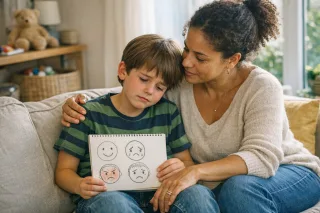
The first step is to create space for the child to talk. Instead of starting with closed questions like “why don’t you want to go?”, it may help to say: “I’ve noticed mornings have been hard. I want to understand what’s going on.”
Avoid minimising with phrases like “that’s just laziness,” “there’s no reason to cry,” or “you just have to tough it out.” Even if the child is exaggerating, the feeling behind the behaviour is real.
Put the child’s feelings into words
Children are not always able to explain what they are going through. It can help to name what you have observed: “You seem very nervous in the morning,” “Maybe school feels too difficult right now,” “It looks like you’re afraid of something.”
When a child feels understood, they tend to become less resistant and more willing to cooperate.
Keep the routine predictable
A simple, stable routine helps a lot: waking up at the same time, breakfast without rushing, clothes ready the night before, and enough time to leave home. The less chaos there is in the morning, the lighter the emotional load.
It is also useful to ensure enough sleep and reduce screen time at night, especially if the child already shows anxiety or finds it hard to switch off.
Offer reassurance without feeding avoidance
It is important to validate the difficulty, but not reinforce the idea that staying home is the normal solution. If the child is sick, of course they stay home. If they are not sick, the goal is usually to return to school with support.
When parents let a child miss school often because of discomfort, anxiety tends to grow. Staying home brings relief in the moment, but can make returning even harder.
Encourage small steps
Instead of focusing only on “going without crying,” it may be more realistic to celebrate small progress: getting dressed without protesting, getting into the car, reaching the school gate, staying until break time, or getting through the whole day. Courage is built gradually.
Avoid humiliating punishments
Harsh punishment, shaming, or comparing a child with siblings or classmates usually makes things worse. Children need limits, but they also need to feel they are being helped, not attacked.
How to talk to the school
If school refusal keeps happening, it is worth contacting the class teacher, form tutor, school psychologist, or another key staff member. The school may notice things the family cannot see: isolation in the playground, difficulties in class, conflict with classmates, or signs of anxiety.
To make the conversation useful, try to bring concrete information:
- When the problem started.
- On which days or at which times it gets worse.
- What physical or emotional symptoms appear.
- Whether there have been recent changes at home or at school.
- What the child says when they are feeling better.
Together, family and school can build a simple plan. Sometimes it helps to adjust drop-off, agree on a welcome adult, reduce initial exposure, or support the child more closely in the first few days.
When to seek professional help
It is a good idea to ask for an assessment if the situation lasts several weeks, if the child is missing school often, if there is intense distress, or if refusal is clearly affecting wellbeing and learning.
A good starting point may be the paediatrician, family doctor, or a psychologist, who can help distinguish between anxiety, adjustment difficulties, emotional problems, physical complaints, and other causes. In some cases, child mental health assessment, ongoing psychological support, or educational support may be needed.
It is also important to seek help sooner if there are:
- Persistent physical complaints with no clear medical cause.
- Daily crying or panic attacks.
- Suspicion of bullying or violence.
- A sharp drop in school performance.
- Withdrawal, prolonged sadness, or marked changes in sleep and appetite.
- Statements like “I can’t take this anymore,” “I wish I could disappear,” or other worrying comments.
What if the child says they really do not like school?
That sentence can hide many things: tiredness, fear, shame, learning difficulties, lack of friends, a need for more support, or even a mismatch with the class style. Instead of replying straight away with “you have to like it,” try to understand what exactly they do not like.
You can ask: “What is the worst part of school for you?”, “Is there any part of the day that feels easier?”, “Who makes you feel better there?” These questions help turn a general “I don’t want to” into concrete clues.
What to do when a child cries at the school gate
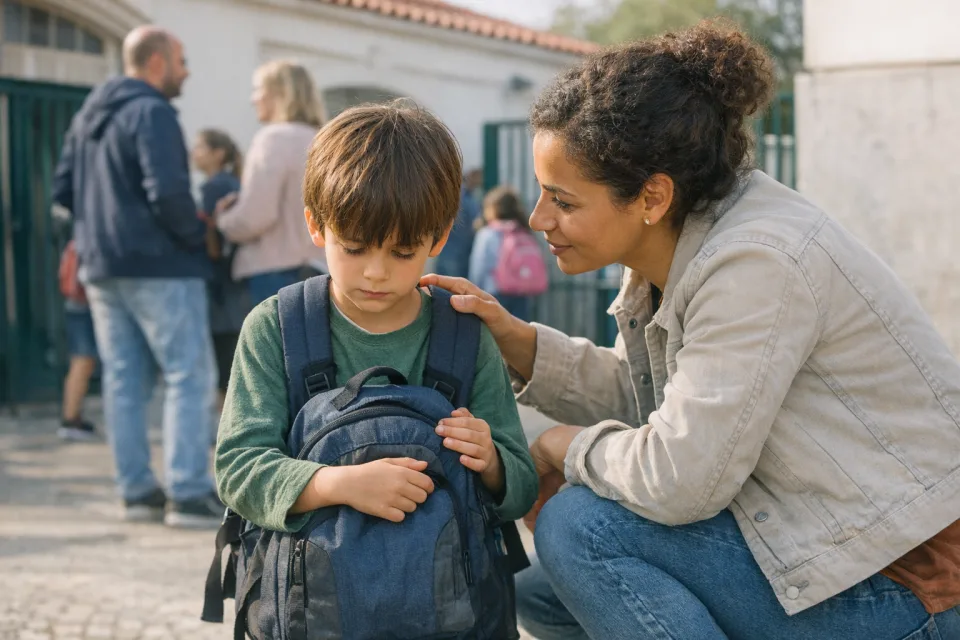
This is one of the hardest situations for parents. The key is to keep goodbye short and consistent. Give a hug, reassure them that you will be back, say the agreed phrase, and hand the child over to the school adult without prolonging the separation.
Long goodbyes usually increase anxiety. The best approach is to show firmness with tenderness: “I know this is hard. I will come back to pick you up at this time. You can do this.”
If the crying is very intense and frequent, the school and family can plan a gradual entry strategy, temporarily and in agreement with everyone involved.
When the problem is more emotional than school-related
Some children seem not to want to go to school, but what lies behind that is fear of failing, low self-esteem, excessive perfectionism, or generalised anxiety. In these cases, the work is not only about the morning routine. It is also important to help the child feel capable, safe, and heard.
Messages such as “you do not need to be perfect,” “making mistakes is part of learning,” “you can ask for help,” and “your worth does not depend on grades” can make a difference over time.
In summary
When a child does not want to go to school, there is almost always a reason behind it. It may be anxiety, bullying, learning difficulties, tiredness, fear, family changes, or another form of distress. Parents’ role is not to force things too quickly or give in to everything, but to understand what the child is communicating and help them regain a sense of safety.
With listening, routine, collaboration with the school, and professional support when needed, most children can begin to feel calmer and more capable again. The earlier the problem is noticed, the easier it is usually to solve.