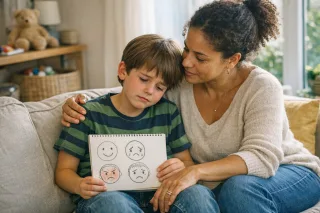

It can be exhausting when a child yells because they were told no. It may be about the tablet, the clothes they have to wear, the end of playtime, the food on the plate, or any everyday boundary. In the moment, it can feel like everything turns into a battle. And yet, that is exactly when the child most needs a calm, firm, and predictable adult.
Yelling does not necessarily mean a child is “badly behaved” or “manipulative.” Often, it simply means they still do not know how to handle frustration, wait, lose, or hear “no” without falling apart inside. The good news is that this can be learned. And it is learned best through clear limits, not long arguments or impulsive punishments.
Why a child yells when told no
In younger children, the brain is still developing the ability to regulate emotions. When a child wants something badly and hears a limit, they may feel frustration, anger, helplessness, or shame. Because they may not yet have enough words to explain what they feel, the body speaks louder: they cry, yell, throw themselves on the floor, slam doors, or answer aggressively.
Some children yell more when they are tired, hungry, overstimulated, or moving between activities. Others do it mainly when they feel they are losing control. In older children, yelling can also be a way to test limits, avoid an instruction, or release built-up tension.
It is important to distinguish between an occasional episode and a frequent pattern. Yelling from time to time in moments of big frustration can be expected. What deserves more attention is when the child reacts this way all the time, with increasing intensity, or when it is seriously affecting family and school life.
What to avoid in the heat of the moment
When a child yells, adults may feel like yelling back, threatening, lecturing, or trying to persuade them at any cost. But in general, these strategies make the power struggle worse.
Avoid:
- yelling back;
- giving long explanations in the middle of the crisis;
- negotiating everything just to stop the noise;
- using sarcasm, humiliation, or comparisons with siblings or classmates;
- threatening consequences that will not be followed through;
- giving in every time just to keep the peace.
When the adult loses control, the child learns that conflict is solved by whoever yells louder. When the adult always gives in, the child learns that yelling works. Neither message helps build healthy boundaries.
How to hold boundaries without starting a war
The goal is not to “win” against the child. The goal is to hold the limit with respect and help the child return to calm. That takes fewer words and more presence.
1. Lower your voice, not your firmness
Speak slowly, in a low voice, with few words. One short sentence is worth more than a long speech. For example: “I understand you’re angry. The answer is no.” Or: “I know you wanted to keep going. It’s time to stop.”
The adult’s calm works like an anchor. Even if the child does not stop right away, they feel that someone is there who can hold the emotion without becoming unsteady.
2. Validate the feeling without giving in to the request
Validating does not mean agreeing. It means showing that you understand the child’s feeling. You can say: “I can see you’re very frustrated” or “It’s hard to hear that limit.” Then keep the decision in place.
This combination matters: the emotion is recognised, and the rule stays the same. The child learns they can feel angry without that changing the limit.
3. Offer choices within the limit
When possible, offer two acceptable options. That helps the child regain some sense of control. For example: “Would you like the blue shirt or the green one?”; “Do you want to tidy the toys now or after we put the books away?”
The choices must be real. If bath time is happening, do not ask whether they want a bath. Ask only how they prefer to do it within the routine already set.
4. Anticipate the hardest moments
Many battles start when the child is already at the edge of tiredness or hunger. Predictable routines help a lot. Warnings before transitions help too. Instead of just saying “It’s finished,” try: “Five more minutes,” “one more game and then we stop,” or “when the timer goes off, we tidy up.”
Anticipating does not eliminate every outburst, but it greatly reduces the intensity of many conflicts.
5. Don’t argue at the height of the emotion
When a child is yelling, their brain is not available for long lessons. First, the intensity needs to come down. Then, once they are calmer, there can be conversation, repair, and learning.
If needed, say only: “We’ll talk when your voice is calm.” And stay nearby without escalating the situation.
6. Be consistent
If the limit exists today and disappears tomorrow, the child gets confused and tests even more. Consistency does not mean absolute rigidity. It means the main rules do not change depending on how tired the adult is.
When the child sees that the limit is predictable, they tend to protest less over time, because they stop seeing the adult as someone who can be overpowered by noise.
What to say when the child yells
A few simple phrases can help a lot. The ideal is to choose a small number and repeat them calmly:
- “I heard what you said. The answer is still no.”
- “You may be angry. You may not yell at me like that.”
- “I’ll help you when your voice is calmer.”
- “If you need to, we can breathe together.”
- “I understand you don’t like it. Even so, this is the limit.”
If the child is very upset, avoid too many questions. Questions like “Why are you doing this?” or “Are you listening to me?” often make the tension worse.
How to act after the crisis
After the child has calmed down, it is important to return to the issue without shame or humiliation. This is not the time to judge the child’s personality, but to teach.
You could say: “Today you yelled when you said you wanted to keep playing. That is not acceptable. Next time, we will try saying ‘I’m angry’ instead of yelling.”
If needed, reinforce a short logical consequence connected to the behaviour. For example, if they yelled during the argument about screen time, they may lose a few minutes of screen time that day. What matters most is that the consequence is known, proportional, and carried out calmly.
It also helps to repair the relationship. A hug, a conversation, or a moment of reconciliation helps the child understand that conflict does not destroy the bond. The limit stays, but the connection remains safe.
What if the child yells all the time?
If yelling is frequent, it is worth looking at the context. Is the child sleeping well? Are there too many stimuli? Are they very tired? Have there been changes at home, at school, or in the family? Are there language difficulties, anxiety, impulsivity, or sensory sensitivity?
Some children need extra support to develop self-regulation. Others react badly because the environment is too chaotic or because adults are alternating between permissiveness and explosions. Looking for patterns helps more than looking for someone to blame.
If you notice very intense aggression, long and frequent outbursts, major difficulty following rules, problems at school, or significant distress for the child or the family, it may help to speak with your paediatrician, a child psychologist, or the school.
The role of adults at home
The way adults respond to conflict has a big impact. Children learn more from what they see than from what they are told. If adults at home solve everything by shouting, the child is likely to copy that model.
It helps a lot when caregivers are aligned: similar rules, predictable responses, and fewer contradictions in front of the child. When one adult says “no” and another says “yes” just to avoid trouble, conflict gets worse.
It is also important to take care of your own emotional state. An exhausted adult has less room to respond calmly. If you feel like you are about to explode, take a safe pause, breathe deeply, and, if possible, ask another adult for help for a few minutes.
When to seek professional help
It is worth seeking support when the yelling is very frequent, when the child hurts themselves or others, when there is destruction of objects, when the behaviour interferes with sleep, school, or family life, or when the adults feel they have already exhausted their strategies.
Seeking help does not mean failing. It means recognising that the child may need tools they do not yet have, and that the family also deserves support.
In summary
A child who yells when told no needs limits, but also adults who do not join the same escalation. The usual path is this: stay calm, acknowledge the feeling, hold the rule, avoid negotiations at the height of the crisis, and return to the issue when everyone is calmer.
It is not easy. There will be better days and harder days. But with consistency and respect, the child learns that feeling angry does not mean they get to control everything, and that they can be told no without losing the bond with the people who care for them.