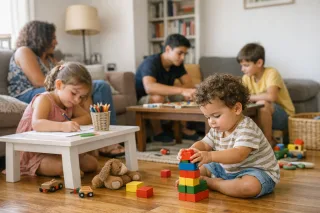
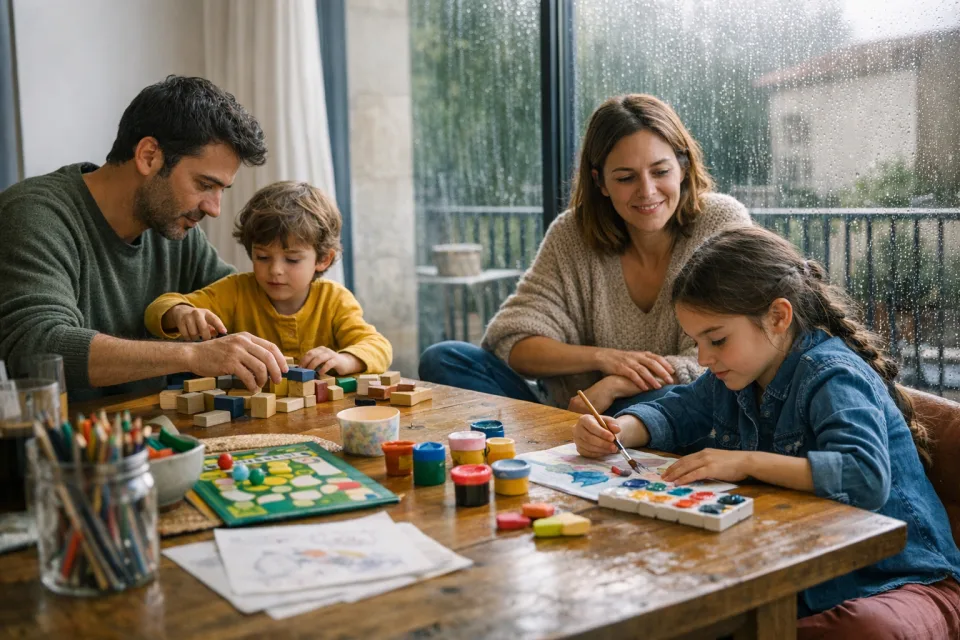
Rainy days can feel like a challenge, especially when children have lots of energy and the house starts to feel too small. It’s easy to be tempted to switch on the TV, hand over a phone, or open a game on a tablet. But screens are not always necessary to keep little ones entertained.
With a few basic materials, a bit of imagination, and realistic expectations, a day stuck indoors can become an opportunity to play, create, move the body, and strengthen family bonds. The goal is not to fill every minute with perfect activities. It’s simply to find simple, safe, and realistic ideas for the moment you’re in.
Before you start: what helps on a rainy day
Not all children react to being indoors in the same way. Some become more restless, others more irritable, and some get bored quickly. That’s why it helps to have a short list of options instead of having to improvise everything on the spot.
It can be useful to gather:
- paper, pencils, coloured pens, and glue
- crayons or washable markers
- empty boxes, cardboard tubes, tape, and blunt scissors
- blankets, cushions, and sheets
- playdough or modelling clay
- books, magazines, and simple games
- a box to keep “rainy day” materials
It also helps to accept that not everything needs to be educational. Playing for the sake of it, laughing, experimenting, and even making a bit of a mess are all part of growing up.
1. Build a den or fort
One of the simplest and most successful activities is building a den in the living room or bedroom. All you need are chairs, blankets, sheets, and clothes pegs. For many children, this kind of play feels almost magical.
The den can be used for reading stories, playing shop, having a picnic on the floor, or just resting. If there are siblings, each child can take responsibility for part of the build. If the child is small, adult help will be important to avoid falls or unstable structures.
2. Create an indoor movement circuit
On a rainy day, the body still needs to move. A simple circuit can burn off energy and reduce restlessness. You don’t need much space.
Example circuit:
- jump in and out of hoops or circles drawn on the floor
- walk in a straight line along tape on the floor
- do five squats
- crawl from one end of the room to the other
- throw a ball into a box
You can also play “follow the leader,” where an adult or child suggests simple movements. It’s a fun way to work on coordination, balance, and attention.
3. Cook or prepare a snack together
The kitchen can be a great ally on rainy days. Depending on the child’s age, they can wash fruit, stir ingredients, spread yoghurt, make fruit skewers, or decorate biscuits.
Besides filling time, cooking together helps develop independence, language, and a sense of quantity. And there’s the added pleasure of tasting something you made together.
Simple ideas:
- fruit salad
- biscuits decorated with yoghurt and fruit
- bread cut into shapes with cookie cutters
- fruit smoothies
- homemade popcorn for a special snack
If the child is small, keep a close eye on knives, hot surfaces, and ingredients that could trigger allergies.
4. Put on a play, make puppets, or act things out
Children love inventing characters. You can use old socks, wooden spoons, toys, or just your hands to create puppets. You can also act out a familiar story or invent an adventure with animals, kings, doctors, astronauts, or superheroes.
This activity supports language, creativity, and problem-solving. It can also help shyer children express emotions in an indirect way.
5. Set up an art corner
Drawing, painting, gluing, tearing paper, and cutting shapes are all good ways to spend time. There’s no need for a complicated project. Sometimes it’s enough to give a child a large sheet of paper and say, “Today you can create your own world.”
Some ideas:
- draw the rain seen from the window
- make animal masks
- create cards for the family
- paint with cotton buds or sponges
- make a group mural
If you want to avoid too much mess, put newspaper under the table and use washable materials. The important thing is to leave room for experimenting.
6. Read stories aloud
A rainy day can be the ideal time to slow down. Reading aloud, listening to stories, or inventing alternative endings are calm and very valuable activities.
To make reading more engaging, you can ask your child to:
- choose the story
- copy the characters’ voices
- guess what will happen next
- draw their favourite scene at the end
If your child already reads on their own, you can suggest taking turns: the child reads one page and the adult reads the next. This small routine can make reading feel more natural and enjoyable.
7. Play board games and card games
Simple games can fill a lot of time and teach a great deal without feeling like “work.” Memory games, dominoes, lotto, puzzles, cards, bingo, and simple track games are all good options.
More than winning, what matters is learning to wait your turn, cope with frustration, follow rules, and have fun together. If the child is younger, you can adapt the rules to keep the game accessible and avoid quick drop-outs.
8. Organise a treasure hunt at home
A treasure hunt can be set up in just a few minutes. Hide clues around the house and challenge your child to find a toy, a book, or a small surprise.
For younger children, you can use picture clues, such as drawings of a chair, a cushion, or the kitchen door. For older children, you can write simple riddles or include small physical challenges between clues.
This activity encourages concentration, excitement, and movement. It also tends to work very well when energy is at its peak.
9. Make music and dance
Even without leaving the house, you can create an upbeat moment with music. You can dance, make simple routines, sing as a family, or improvise instruments with spoons, pans, and boxes.
If the house is getting too noisy, you can turn it into a “gentle orchestra” session, with slow rhythms and quiet sounds. This helps children notice different levels of intensity and regulate their energy.
10. Play at real-life jobs and routines
Many children enjoy copying the adult world. On a rainy day, that can be useful. They can play at being at the shops, at school, at the doctor’s, in a restaurant, at the hairdresser, or in a workshop.
This kind of pretend play helps develop language, imagination, and understanding of everyday life. It can also be a chance for parents to notice worries or themes the child may be dealing with.
11. Try simple experiments
Some homemade experiments are safe, easy, and fascinating for school-age children. For example, mixing water with food colouring, observing what floats or sinks, or seeing how salt reacts on different surfaces.
It’s important to choose very simple, supervised experiments without dangerous products. The value lies in curiosity and observation, not complexity.
12. Create a special rainy-day routine
Sometimes the secret is not a different activity. Often it helps to have a special, predictable routine for these days: a movement session, a snack, a calm activity, reading, and then free time.
Children feel safer when they know what will happen next. That can reduce tantrums and arguments, especially on long days at home.
How to stop the day from feeling too heavy
On a rainy day, there’s no need to keep children busy every minute. Boredom can be part of the day and may even spark creativity. What matters most is offering alternatives and keeping some structure.
Some useful strategies:
- alternate active activities with calmer moments
- offer limited choices: “Would you rather draw or do a puzzle?”
- don’t suggest too many activities at once
- accept that your child may change their mind
- keep a few surprise materials for crisis moments
If you have siblings of different ages, it can help to create parallel tasks. While one child cuts and pastes, another can build with blocks or paint. Not every activity has to be the same for everyone.
What if your child only asks for screens?
It’s normal for many children to ask for TV, tablets, or video games, especially if they are used to them often. Rather than getting into a long battle, it can help to set rules in advance and keep the limit calmly.
For example: “Today we’re going to play first, and then we’ll see if there’s time for a cartoon.” Or: “First we do this activity, then you can choose between two options.”
The most important thing is not to turn a rainy day into a war. Firmness can coexist with empathy. Children usually accept limits more easily when they feel understood.
Quick ideas for different ages
Up to 3 years: songs, blocks, stacking boxes, picture books, soft balls, playdough, supervised water play in a basin.
From 4 to 6 years: puppets, puzzles, memory games, free drawing, dens, dancing, simple cooking.
From 7 to 10 years: treasure hunts, simple experiments, board games, storytelling, building challenges, small kitchen tasks.
Pre-teens and teenagers: cooking something new, organising their room, choosing music for the family, card games, preparing a themed afternoon, looking at old photos and putting together an album, helping younger children with an activity.
Conclusion
Rainy days don’t have to be wasted days or days that depend on screens. With creativity, a little preparation, and realistic expectations, it’s possible to turn home into a place of discovery, play, and calm.
You don’t need to do everything. Just choose one or two ideas that make sense for your child’s age, the space you have, and your family’s energy that day. Often, it’s the simple, improvised moments that children remember most.