Play is learning, without feeling like work
Play is not just a way to pass the time. For babies, children and teenagers, play helps build language, coordination, attention, creativity, independence and social skills. And the best part is that it does not have to be complicated.
Many families feel pressure to choose educational games, structured activities and the “right” toys. But the truth is that, on most days, what works best is simple, repeated play that fits the child’s age. A box, a spoon, a song, a ball or a blanket can be more valuable than many sophisticated toys.
The key is to understand what a child can do at each stage and offer small, safe and fun challenges. That way, play stops being a task for parents and becomes a moment of connection and development.
How to choose age-appropriate play
Before making any list, it helps to keep a few simple principles in mind:
- Less is more: a few options usually stimulate better than too many things at once.
- Safety first: play should match the child’s size, strength and curiosity.
- Adult participation: especially in the early years, adults help get things started, model the activity and keep it going.
- Repetition helps: repeating the same game helps consolidate learning.
- Adapt to the real child: chronological age matters, but every child develops at their own pace.
If a child is not interested in an activity, that does not necessarily mean there is a problem. It may simply not be the right moment, or the idea may not suit their stage, energy or temperament.
From 0 to 6 months: bonding, voice and discovery
At this stage, babies mainly need contact, safety and simple stimulation. There is no need to constantly “entertain” them. Often, the best stimulation is the calm presence of an adult.
- Talk face to face: describe what you are doing, sing, or copy the baby’s sounds.
- Show contrasts: black-and-white objects, or bright colours, at close range.
- Play with faces and expressions: babies learn by watching faces.
- Tummy time: short supervised moments on their tummy help strengthen the neck and trunk.
- Simple mobiles and rattles: useful if they are safe and used for short periods.
What develops a baby most at this stage is human interaction: looking, responding, waiting and repeating. That builds connection and supports future communication.
From 6 to 12 months: moving, exploring and repeating
The baby starts to sit, crawl, grasp more effectively and understand cause and effect. Play should invite safe exploration.
- Hide and reveal: cover a toy with a cloth and then uncover it.
- Cups and boxes: fill, empty, stack and knock down.
- Everyday objects: wooden spoons, plastic containers, different fabrics.
- Soft balls: roll the ball back and forth.
- Mirror play: look at the face, hands and movements.
At this age, children often love repetition. Adults may feel the urge to move on, but repetition helps babies consolidate what they are discovering.
From 1 to 2 years: movement, language and independence
Between the first and second year, children want to move more, try things out and say new words. Play should follow that impulse.
- Throwing balls into a target: use a box or basket.
- Stacking blocks: simple towers, then knocking them down.
- Water play: filling and pouring, always with supervision.
- Picture books: point to animals, objects and people.
- Copying gestures: clapping, blowing kisses, making animal sounds.
- Helping games: tidying toys, putting socks in a basket, carrying a nappy.
Simple pretend play starts to appear. Feeding a doll or putting a teddy to sleep are important signs of symbolic development.
From 2 to 3 years: pretend play, language and limits
This is a very imaginative age. Children begin inventing stories, repeating routines and testing limits. Play can help channel that energy.
- Symbolic play: cooking with toy pots, caring for dolls, playing doctor.
- Simple treasure hunt: looking for an object with very easy clues.
- Large puzzles: few pieces and familiar images.
- Playing shop: exchanging objects, naming fruit and pretending to buy things.
- Songs with gestures: help memory, language and coordination.
At this age, conflict is normal. Play can also help children practise taking turns, waiting, asking, refusing and calming down again. A present adult helps children learn without turning everything into a battle.
From 3 to 5 years: imagination, simple rules and coordination
In preschool years, children can follow simpler instructions and enjoy playing with other children. Pretend play becomes richer and games can include small rules.
- Job games: firefighter, cook, teacher, vet.
- Races and obstacle courses: jumping, crawling, balancing, going around obstacles.
- Imitation games: freezing like statues, copying movements, guessing animals.
- Simple arts and crafts: painting, tearing paper, gluing, stamping with sponges.
- Basic table games: lotto, simple memory games, adapted dominoes.
This is also a great age for outdoor play whenever possible. Running, climbing, going up and down, throwing balls, and playing in dirt or sand help the body develop and support energy regulation.
From 6 to 9 years: cooperation, strategy and confidence
With school, children gain more ability to follow rules, cooperate and think through simple strategies. They still need plenty of play, even if the school routine already takes up a lot of time.
- Team games: ball games, tag, age-adapted dodgeball.
- Builds and constructions: Lego, magnetic pieces, blocks, tracks and circuits.
- Logic challenges: mazes, sequences, category games.
- Creative play: inventing stories, puppet theatre, drawing comic strips.
- Short table activities: cards, memory, board games with a path.
At this stage, play also helps children handle frustration. Losing a game, waiting their turn or changing strategy are valuable lessons for school and for life.
From 10 to 12 years: independence, friends and real interests
Before adolescence, many children start preferring activities with friends, more complex games and their own interests. That does not mean they stop playing. They just play differently.
- More elaborate board games: simple strategy, cooperation, card games.
- Physical challenges: cycling, skates, skipping rope, walks, ball games.
- Creative projects: building, cooking, making models, filming short videos with supervision.
- Games with agreed rules: the child already helps define the rules.
- Group activities: scouts, sport, theatre, music, dance.
This is a good stage to respect individual preferences. Not every child enjoys competitive sport, and not everyone wants arts and crafts. The important thing is to have opportunities to try and choose.
And in adolescence, does play still make sense?
Yes. The name may change, but the need remains. Teenagers need mental rest, movement, creativity and connection with others. If “play” sounds too childish, it can help to think in terms of active leisure, games, sport, music, cooking, group outings or creative challenges.
In adolescence, play can mean:
- team games;
- dancing;
- skateboarding, cycling or another sport;
- board games with friends;
- artistic activities;
- cooking as a family;
- exploring hobbies without performance pressure.
The most important thing is that teenagers have spaces where they can be creative, move their bodies and spend time with others without constant pressure.
How to play more without complicating the routine
For many families, the problem is not a lack of ideas. It is a lack of time, energy or space. So the goal should not be perfect activities, but small opportunities to play throughout the day.
- Use what is already at home: cushions, boxes, spoons, old clothes, ribbons, scarves.
- Combine play with routine: count steps to the kitchen, sing while tidying up, race to the bath.
- Choose one idea a day: there is no need to prepare much.
- Let the child lead part of the play: following their initiative strengthens independence.
- Do not stretch it out once it no longer makes sense: a short, good game is better than a long, forced one.
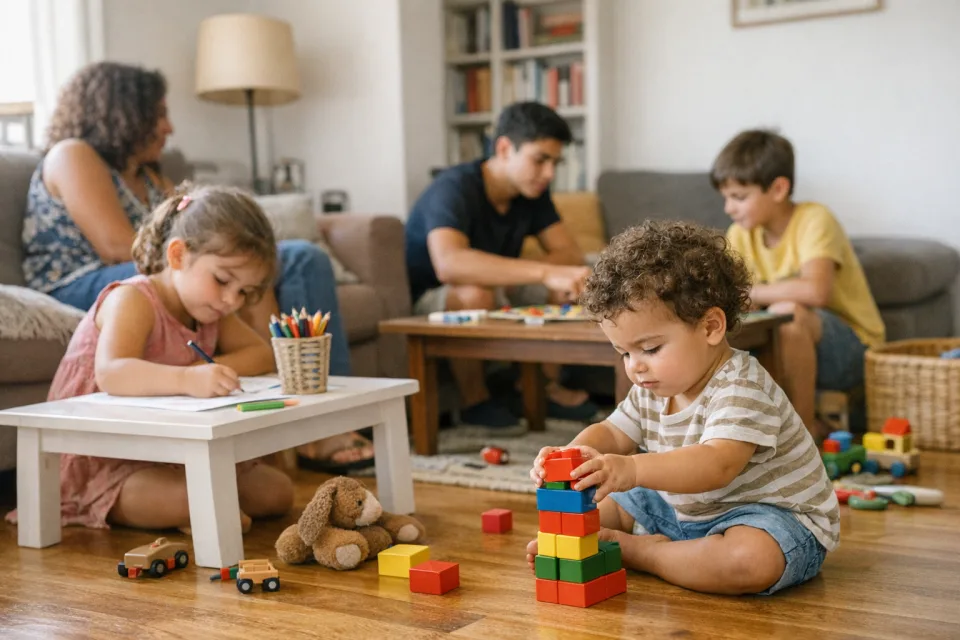
If there are siblings, play can be adjusted so everyone takes part without too much competition. For example, an older child can help a younger one build. But each child should also have play that suits their own age.
When can play be a cause for concern?
In general, changes in interest in play are normal. Still, it is worth speaking with your paediatrician or another professional if you notice signs such as:
- a very marked lack of interest in play for a long time;
- persistent difficulty interacting, imitating or making eye contact;
- very intense repetitive movements or behaviours that affect daily life;
- strong rigidity and distress with any change;
- loss of skills the child already had;
- play that is very limited for the child’s age, together with other developmental concerns.
Child development should not be measured by one single sign. The most useful approach is to look at the whole picture: language, interaction, movement, curiosity and overall well-being.
Conclusion: play is simple when it matches the child’s age
Age-based play ideas do not need to be a rigid checklist or require special materials. The essential thing is to offer children safe, simple experiences that fit the stage they are in.
In the first months, play is looking, talking and responding. In the early years, it is moving, repeating and exploring. During school years, it is cooperating, imagining and trying out rules. In adolescence, it remains important to have space for movement, friendship, creativity and mental rest.
If you want to sum it all up in one practical idea, think like this: the best play is the one a child can do today, with joy, with a little challenge, and with an adult who is present enough without making family life more complicated.