
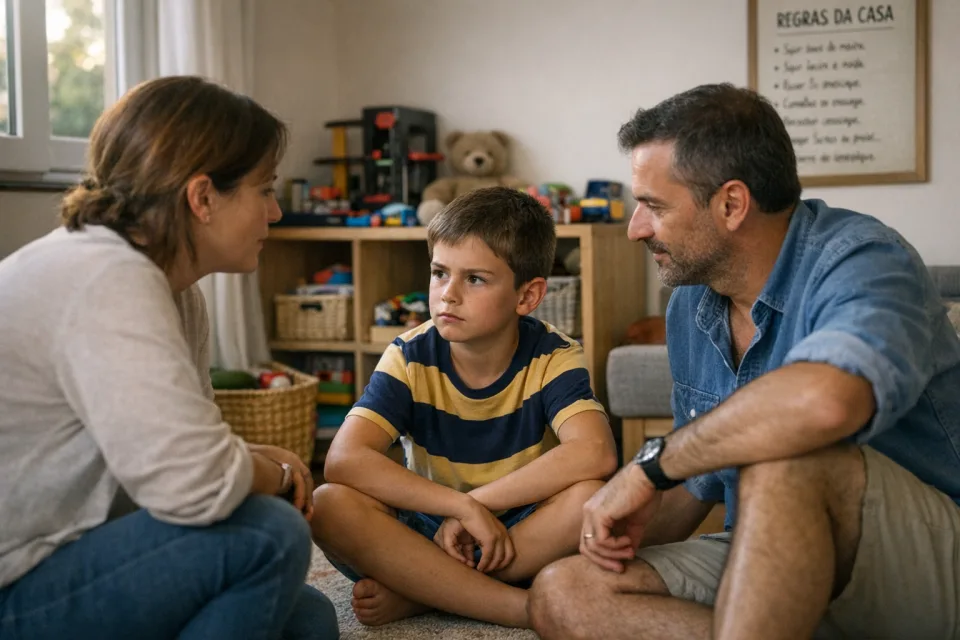
Do punishments work? The question almost every family asks
When a child hits, talks back, has a tantrum, disrespects rules or repeats a behaviour that has already been corrected several times, it is natural to ask: do punishments work? The short answer is: sometimes they stop the behaviour in the moment, but they do not always teach what to do instead.
In practice, many punishments have an immediate effect because the child wants to avoid losing a privilege, being taken off a screen or being separated from something they enjoy. But that does not mean learning has happened. If the goal is to educate, not just stop the behaviour out of fear, it is worth looking at more consistent and educational alternatives.
This topic matters at every age: in childhood, pre-adolescence and adolescence. Each stage calls for a response that fits the child's development, maturity and the relationship between parents and children.
What is a punishment, really?
In many homes, the word punishment can mean different things: not being allowed to play, losing a phone, going to their room, no television, or even a harsh telling-off. Some punishments are milder and more educational, while others are more humiliating or disproportionate.
There is an important difference between consequence and punishment:
- Consequence: linked to the behaviour and helps the child understand the connection between action and result. Example: if the child leaves toys scattered around, they help tidy them up before playing with something else.
- Punishment: often a penalty that tries to create discomfort without teaching a concrete alternative. Example: being banned from playing for several days for speaking rudely.
Not every consequence is educational, but natural and logical consequences are usually more useful than arbitrary punishments.
Do punishments work in the short term?
Yes, sometimes they do. A child may stop immediately because they are afraid, embarrassed or want to get back what they lost. The problem is that this does not always address the cause of the behaviour.
Punishments can have quick results when the child:
- is young and needs very clear limits;
- is tired, frustrated or impulsive;
- is afraid of losing something they value;
- already understands the rule and the link between behaviour and consequence.
However, when punishment is repeated often, the child may start to:
- only obey when being watched;
- feel resentment or rebellion;
- lie to avoid punishment;
- focus more on not getting caught than on learning;
- lose emotional connection with their parents.
And in the long term?
This is where the issue becomes more delicate. Frequent, harsh or unpredictable punishments may stop some behaviours, but they have important limits. They do not teach self-regulation, do not build empathy on their own and can create a relationship based more on fear than trust.
Effective parenting needs three pillars:
- clarity about what is expected;
- consistency in how adults respond;
- relationship, so the child feels safe while learning.
If a child only receives correction when they fail, but rarely receives guidance, practice and positive reinforcement, the behaviour is likely to repeat.
Why do children misbehave?
Often, difficult behaviour is just the tip of the iceberg. Behind it may be:
- tiredness or hunger;
- a need for attention;
- difficulty coping with frustration;
- sensory overload;
- jealousy of siblings;
- lack of routine;
- too much screen time;
- aggressive models at home or school;
- a wish to test limits;
- emotional or learning difficulties.
When parents only look at the visible behaviour, they may respond with punishment without understanding what is causing it.
Educational alternatives to punishment
There are several ways to correct behaviour without relying on punishment all the time. The aim is not to “let everything slide”, but to educate with firmness, respect and clarity.
1. Logical consequences
Instead of a penalty unrelated to the behaviour, use a consequence that is connected to it. If the child deliberately spills water, they help clean it up. If they scratch the table, they take part in cleaning it. If they misuse an object, they temporarily lose access to it.
This teaches responsibility, not just obedience.
2. Positive reinforcement
Children learn a great deal from what gets attention. When a desired behaviour is noticed and valued, it tends to happen again. Praise specific effort:
- “I liked seeing you tidy up without me having to repeat myself.”
- “Thank you for speaking calmly.”
- “I noticed you waited your turn today.”
Effective praise is specific and sincere, not exaggerated.
3. Clear and few rules
A home with too many demands and too little predictability creates more conflict. It is better to have a few rules, clearly explained and consistently applied. For example:
- we speak without insults;
- we do not hit;
- screens are only used at the agreed time;
- toys are put away before leaving the room.
When the rule is clear, correction becomes less confusing.
4. Anticipate difficult situations
Many conflicts can be avoided if adults prevent the critical moments. A young child copes less well with transitions when they are sleepy or hungry. A teenager reacts worse if they feel humiliated in public.
It helps to say:
- “In 10 minutes we are leaving.”
- “When you get home, you do your homework first and then screen time.”
- “If you feel angry, you can ask for a moment to calm down.”
5. Offer choices within limits
Instead of rigid orders, offer limited choices. This reduces opposition and gives the child some sense of control.
Examples:
- “Do you want the blue jumper or the green one?”
- “Do you want to have a bath before or after dinner?”
- “Would you rather do your homework before snack time or after?”
The options must be acceptable to the adult. This is not about negotiating everything.
6. Time to calm down, not to shame
A pause can help, especially with younger children. But it should not be used as emotional rejection. The point is to lower the intensity, not to embarrass the child.
You can say:
- “You are very angry. Let’s breathe and then talk.”
- “Come with me to calm down and then we will try again.”
Once calm, comes the conversation and repair.
7. Repair the mistake
When a child hurts someone, breaks something or breaks a rule, the focus should include repair. Saying sorry can be a start, but it is not always enough. The child may also help fix, tidy, replace or do something kind to make amends.
Repair teaches empathy and responsibility in a concrete way.
What to do instead of “punishing on the spot”
When the behaviour happens, parents do not always manage to think calmly. Even so, it helps to follow a simple guide:
- Stop and keep everyone safe.
- Name the behaviour: “Hitting is not acceptable.”
- Hold the limit without shouting or threatening.
- Explain the consequence or rule.
- Offer an alternative: “You can say you are angry.”
- Return to the conversation later, when everyone is calm.
Sometimes, the hardest part is not correcting the child. It is the adult staying firm without escalating into shouting, threats or humiliation.
When punishment can make behaviour worse
There are situations where frequent punishments tend to make the problem worse:
- when the child is already very anxious or insecure;
- when there are constant family conflicts;
- when the behaviour is linked to attention, language or developmental difficulties;
- when parents apply different punishments from each other;
- when the child lives under constant criticism.
In these situations, punishment can increase opposition, sadness or withdrawal. If the behaviour is persistent, intense or affecting school and family life, it may be useful to seek support from a paediatrician, child psychologist or another health professional.
And what about teenagers?
In adolescence, very childish punishments usually work worse. Teenagers do need boundaries, but they also need respect, dialogue and some room for autonomy. If parents respond only with bans, the relationship can become a permanent power struggle.
With teenagers, it usually helps more to:
- agree on rules before problems happen;
- explain the reason for the limits;
- set clear and proportionate consequences;
- be consistent about schedules, school and screens;
- keep the door open to talk without humiliation.
The goal remains the same: to teach responsibility. Only the approach changes.
Does educating without punishment mean letting everything happen?
No. This is one of the biggest misunderstandings. Educating with less punishment does not mean being permissive. It means correcting with educational intention.
A child needs adults who know how to say:
- yes, with warmth;
- no, with firmness;
- wait, with patience;
- let’s try again, with confidence.
Boundaries are a form of care. The difference lies in how they are applied.
When to seek help
It is worth seeking support if:
- aggressive behaviour is frequent;
- the child is constantly in conflict with adults and peers;
- there are marked changes in sleep, appetite or mood;
- tantrums or outbursts are much greater than expected for the child's age;
- parents feel they have already lost control of the situation;
- there is suspicion of emotional, learning or developmental difficulties.
Sometimes the problem is not “lack of discipline”, but the need for a more specialised assessment and support.
Conclusion
So, do punishments work? They may stop a behaviour in the moment, but they are rarely the best response on their own. Parenting is more than punishing. It is teaching, repeating, adjusting, repairing and maintaining a safe relationship even when there is conflict.
Educational alternatives are not permissive or “soft”. They are strategies that help the child learn what to do, instead of only fearing what happens when they get it wrong. And that usually leads to stronger results over time.
In practice, parents do not have to choose between “punish everything” and “let everything go”. There is a middle path: firmness with respect, limits with explanation and correction with presence.