
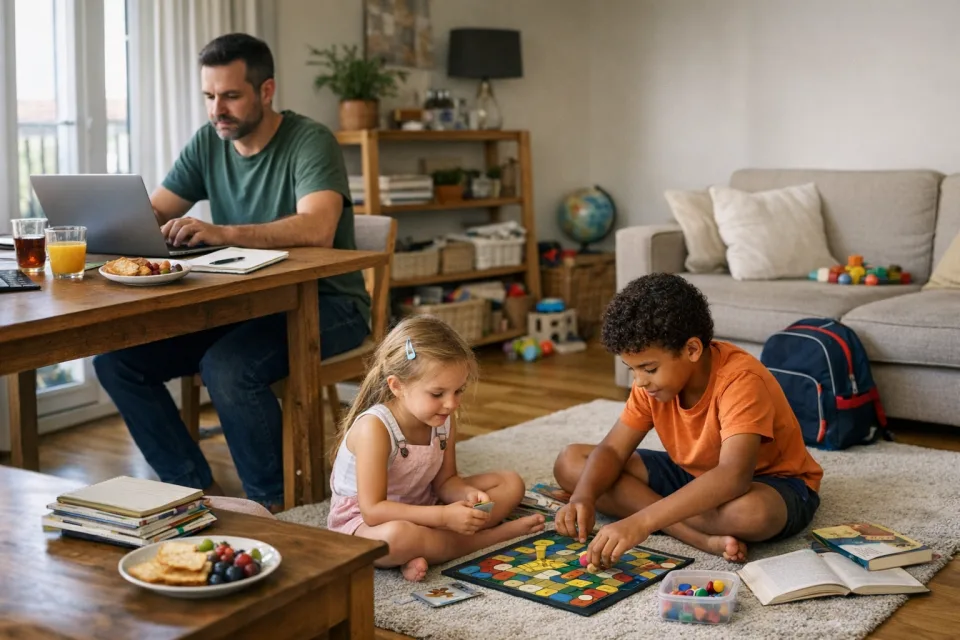
School holidays: how to find balance at home
School holidays bring a different rhythm to family life. For children, they are a time for rest, play, and freedom. For many parents and carers, they can also be demanding weeks, because work continues, schedules shift, and logistics become more complicated.
There is no perfect way to organise the holidays. The goal is not to fill every day with activities or keep everything the same as during term time. What matters most is finding a realistic balance between work, rest, presence, and flexibility. When there is some structure, children usually feel safer and adults feel less overwhelmed.
This article brings together practical ideas to help you manage school holidays with less stress, while respecting your family’s needs and your children’s ages.
1. Start by accepting that not everything will work as it does during the rest of the year
One of the biggest sources of tension during the holidays is trying to keep the same level of productivity as always. If you have children at home, it is normal for focus at work to drop at times. It is also normal to have more noise, interruptions, requests, and unexpected moments.
Instead of expecting an “ideal” day, it can be more useful to think in blocks of time. For example: morning for more demanding tasks, afternoon for lighter work, and set times to be with the children. This shift in mindset reduces guilt and helps you adapt your routine to reality.
It is also important to adjust expectations for children. They do not need perfect holidays, full of activities and outings every day. They need to sleep, play, slow down, and feel some predictability.
2. Define what is essential for your family
Before organising calendars and activities, it is worth answering three simple questions:
- What absolutely cannot fail during these weeks?
- Which work hours really need to be respected?
- What rest time does the family not want to give up?
Maybe the essential thing is making sure someone looks after the children during working hours. Maybe it is keeping the sleep routine. Maybe it is reserving one afternoon a week for complete rest, with no plans.
When a family identifies what is essential, it becomes easier to say no to what is optional. School holidays do not need camps, paid activities, trips, or frequent outings. What works for one family may be too much for another.
3. A simple routine helps more than you might think
Children usually cope better with the holiday period when they know what to expect. You do not need a rigid timetable, but rather a predictable structure for the day. A simple routine can include:
- approximate wake-up time
- breakfast and hygiene
- free play time
- a quiet moment for reading, drawing, or puzzles
- time outside or physical activity
- lunch
- rest or quiet time
- afternoon activity
- dinner and bedtime routine
Even when days change, having certain fixed points brings security. For younger children, using pictures or a simple visual list can help. For older children, agreeing the plan at the start of the week often works well.
A routine is not meant to control everything. It helps reduce constant arguments, avoid long periods of boredom, and make things easier for the adult who is working.
4. Plan the week, not every minute
During the holidays, trying to predict every detail can increase fatigue. Instead, it can be more effective to plan by week. For example:
- 1 or 2 days with activities outside the house
- 2 quieter days at home
- 1 special family moment
- free time for spontaneous play
Having a weekly plan gives direction without overwhelming the atmosphere. It also helps make better use of everyone’s energy. If a child is more tired, a calm morning may make more sense than a long outing. If parents are under a lot of work pressure, a more home-based week may be the wisest option.
It helps to prepare a small list of backup ideas for harder days: books, board games, modelling clay, drawing, building toys, music, sensory boxes, or simple cooking tasks with supervision.
5. Organise work blocks in advance
If possible, let your team, clients, or colleagues know in advance about the times when you will be less available. It can also help to get ahead on tasks before the holidays begin. That way, the days feel less packed and there is more room for interruptions.
Some practical strategies include:
- replying to messages at set times
- leaving the most important meetings for when support is available at home
- using nap time or quiet time for focused tasks
- making short daily priority lists
- accepting that not everything will be finished right away
For people working from home, dividing the space physically also helps. Even a specific work corner can signal to children that there is a time when the adult is busy. This does not remove interruptions, but it reduces confusion.
6. Share responsibilities between adults when possible
When there are two adults at home, a clear division of responsibilities can make a big difference. One adult may stay with the children for part of the day while the other works, then they swap. Or they may divide tasks by fixed periods: mornings, afternoons, or alternate days.
The most important thing is to agree expectations clearly. Vague phrases like “we’ll help each other” can easily lead to frustration. It is better to decide who does what, at what time, and on which days.
If two adults are not available, it may help to build support from family members, trusted neighbours, friends, or occasional activities. It is not always possible to manage everything alone, and asking for help is not a sign of failure.
7. Make room for real rest
Rest during the holidays does not mean simply sleeping more. It also means stepping away from constant pressure. Children need time for free play, a bit of boredom, inventing games, and being without too much stimulation.
As is sometimes believed, filling every minute with plans does not improve the holidays. It can actually increase irritability, tiredness, and conflict. A simpler day, with time to play at home, can be far more restorative than a packed schedule.
For adults, rest should also be taken seriously. Whenever possible, it is worth protecting small windows without tasks, even if they are only 20 or 30 minutes a day. A short break can help restore mental energy.
8. Use screens with intention, not as the only solution
During the holidays, it is normal for screens to come up more often. In reasonable amounts and with clear rules, they can be a useful tool for moments when an adult needs to work or rest. The problem usually appears when screens take over all the free time.
The ideal is to decide in advance when they can be used and for how long. It also helps to choose age-appropriate content and avoid automatic screen use first thing in the morning or before bed.
Some families include screens as part of the day’s plan, for example after lunch or during a short, defined period. When the rule is clear, there are fewer repeated requests and less constant negotiation.
If you would like to learn more about digital balance, it may be useful to look at guidance from the Portuguese Directorate-General of Health and online safety organisations, especially for older children.
9. Don’t forget sleep, meals, and movement
During the holidays, it is easy to relax schedules too much. Some flexibility makes sense, but big changes can leave children more irritable and tired. Going to bed too late, eating irregularly, and spending the whole day sitting down tend to worsen mood and cooperation.
It is a good idea to keep, as much as possible:
- a consistent bedtime
- main meals at roughly similar times
- daily time outdoors or physical movement
- water available throughout the day
For many families, evenings are the most sensitive time. If children fall asleep later during the holidays, it can also be harder to get back into the school routine afterwards. Small adjustments, like reducing evening screen time and creating a calm bedtime ritual, can help a lot.
10. Involve children according to their age
When children take part in planning, they feel more included and are often more willing to cooperate. Younger children can choose between two activities. Older children can help decide the weekly plan, prepare a snack, pack a bag for an outing, or organise a play area.
It is also useful to give age-appropriate responsibilities. Small, simple household tasks help fill time and build independence: tidying toys, setting the table, sorting clothes, watering plants, or helping prepare a meal.
At the same time, it is good to remember that holidays are not the time to turn the home into a school. Tasks should be suitable, short, and clear, without too many demands.
11. When there are siblings, the challenge can be bigger
School holidays can intensify conflict between siblings, especially when there are differences in age, interests, or need for attention. One useful approach is not to expect them to play together all the time. Not every conflict needs to be solved by constant sharing.
It can help to create separate moments, alternate activities, and offer different opportunities for each child. One may need movement, another silence. One may want company, another more independence.
If there are frequent arguments, it is important to notice whether the children are tired, hungry, or spending too much time together without a break. Many holiday tantrums have more to do with overload than with bad intentions.
12. Less guilt, more realism
Many parents feel guilty during the holidays because they cannot always be present, because they rely on screens, or because they do not organise special plans every day. But family life does not need to treat the holidays as a perfect project.
What children remember most is not the number of activities, but the feeling of safety, availability, and enough attention. A simple day, with calm, play, and a less-stressed adult, can matter more than a packed schedule.
If things are especially difficult, it is worth simplifying even more. Reducing commitments, accepting help, lowering expectations, and creating basic routines may be the best path.
Conclusion
Organising work, rest, and children during school holidays is an exercise in balance. It requires accepting limits, adjusting schedules, sharing responsibilities, and leaving room for the unexpected. You do not need to do everything. You need to do what is possible in a sustainable way.
With a bit of planning, a simple routine, and realistic expectations, the holidays can become lighter for the whole family. Not perfect, but good enough. And that already makes a big difference.
FAQs
How can I work from home with children during the holidays?
The best help is usually a simple routine, defined work blocks, activities prepared in advance, and realistic expectations. Whenever possible, use your most focused periods for the hardest tasks.
Do children need strict schedules during the holidays?
They do not need rigidity, but they do benefit from some predictability. A flexible routine with approximate times for sleep, meals, and play usually works better.
Is it wrong to allow more screen time during the holidays?
Not necessarily. Screens can be used with intention and clear limits. The key is that they do not completely replace play, movement, and rest.
How can I avoid so many arguments between siblings?
It helps to have separate moments, different activities, and enough breaks. It does not always make sense to expect them to be together all the time.
What should I do if I feel overwhelmed?
Try to simplify the routine, reduce commitments, and ask for help when possible. If the overwhelm is ongoing, it may be important to speak with a health professional or psychological support service.