Summer holidays bring a lovely promise: more family time, less rushing, and days with room for play. But in practice, many parents and carers find that the days can become too unstructured, children get more restless, and home quickly slips into chaos mode.
The good news is that you do not need a packed schedule for summer to go well. Instead of trying to keep a rigid routine, many families benefit more from a light routine: a few fixed points in the day, predictable enough to give children a sense of safety, but flexible enough to enjoy good weather, rest, and spontaneous plans.
This balance helps children feel more secure, reduces arguments, and gives adults less mental load. It also makes room for something important: actually experiencing the holidays as holidays.
Why do children need some routine during the holidays?
Even when there is no school, children still benefit from predictability. Knowing more or less what is going to happen helps them regulate emotions, cope better with change, and feel more confident. This is especially important for younger children, but also for many older children and teenagers.
A holiday routine is not about controlling every minute. It is about answering the simple questions children ask, even when they do not say them out loud: When do I wake up? When do we eat? When do we go out? When do we play? When do we rest?
When these answers are partly predictable, there is less resistance, fewer tantrums, and less constant negotiation.
What is a light routine?
A light routine is a simple structure for the day, with room for flexibility. It does not need minute-by-minute schedules. It can be based on blocks:
- a calmer morning
- playtime or an activity outside the house
- lunch and rest
- a freer afternoon
- a quieter late afternoon
- a more stable bedtime routine
The key is to keep a few repeated habits, even if everything else changes. For example: breakfast at roughly the same time, a short outing in the morning, rest after lunch, and a simple bedtime ritual.
The benefits of a simple summer routine
A light routine can bring several benefits to family life:
- More predictability for children
- Fewer conflicts throughout the day
- Better emotional regulation, especially on hot or long days
- More autonomy, because children know what to expect
- Less impulsive screen time, when alternatives are planned in advance
- More real rest for both children and adults
Holidays do not need to be a non-stop schedule of activities. Often the best days are the ones that combine a bit of movement, some healthy boredom, family moments, and pauses to recharge.
How to build a light summer routine
You do not need to start with big plans. It can help to think about three questions:
- What needs to happen every day?
- What can change without causing problems?
- What usually creates the most stress for the family?
Then build a simple base. For example:
- Morning: wake up, wash, breakfast, an outing or active play
- Midday: lunch, rest, nap or quiet time
- Afternoon: free play, reading, beach, park, board game, simple cooking, visiting relatives
- Evening: bath, dinner, tidy up the essentials, story or chat, bed
The important thing is for the family to know the day’s anchor points. That reduces the feeling of disorganisation, which is very common during long holidays.
Useful ideas for summer days with children
When inspiration runs low, it helps to have a short list of ideas that do not require much preparation. The goal is not to entertain children all the time, but to offer realistic options.
1. Water play
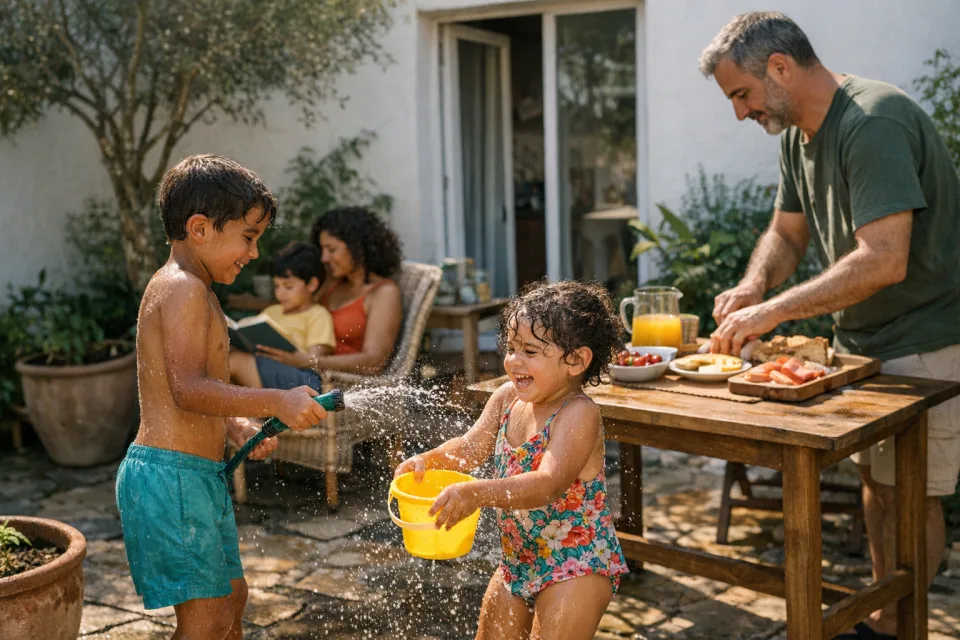
On a hot day, water solves a lot. It can be a basin in the yard, cups, sponges, water pistols, watering plants, or playing with containers. These are simple activities and usually very well received.
2. Short outdoor walks
Not every day needs a big outing. A walk around the neighbourhood, a nearby park, or a short stroll in the late afternoon can do wonders for children’s mood and energy.
3. Reading time or audiobooks
Read with younger children or offer books, magazines, or audio stories to older ones. It is a good way to slow the pace down without relying too much on screens.
4. Simple family cooking
Making fruit salad, fruit skewers, bread with simple toppings, or a snack for the beach can be a fun and educational activity. Children like feeling that they are helping.
5. Board games and card games
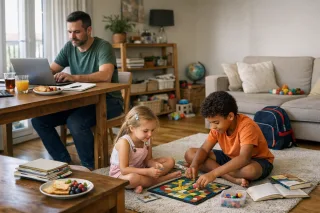
These are useful for days at home, especially when it is very hot or when the family needs a calmer moment. They do not need to last hours; ten or fifteen minutes is enough.
6. Creative challenges
Drawing, painting, building with boxes, making collages from recycled materials, or inventing a play. Creativity helps fill the time without always depending on bought or complicated activities.
7. Purposeful tasks
Children can help fold towels, organise toys, choose fruit, set the table, or water the plants. Rather than seeing everything as a chore, many feel proud to take part in family life.
How to deal with screens without constant battles
During the holidays, screen use usually increases. That is not, by itself, a serious problem. The problem comes when screens take over the whole day, create daily arguments, or replace sleep, play, and family time.
A calmer approach is to set simple rules before the day starts. For example:
- when they can use screens
- for how long
- which times are screen-free, such as during meals or before bed
- what happens if the rule is broken
If possible, avoid negotiating with every request. The more predictable the rule is, the less emotional energy it takes. And whenever you can, offer real alternatives. It is not enough to say “no screens”; there needs to be something else to do next.
Rest is part of the holidays too
Many parents feel guilty when the day has not been “made use of”. But holidays do not have to be productive. Tired children become more irritable, less cooperative, and more dependent on constant stimulation.
Making time for rest is not laziness. It is care. That may mean:
- a nap for younger children
- quiet time after lunch
- a late afternoon with no commitments
- an earlier bedtime on intense days
If a child resists rest, try presenting it as a natural part of the day rather than as a punishment.
How to adapt the routine to the child’s age
Babies and young children
They mainly need predictability around sleep, meals, and comfort. Big changes or too much stimulation can leave them more tired and demanding. Keep an eye on heat, hydration, and sun protection. Simple routines work better than long outings.
School-age children
They can already take part more in organising the day. They can choose between two or three activity options, help with small tasks, and understand simple agreements about screens and schedules. They also benefit from free time without constant occupation.
Pre-teens and teenagers
They need some personal space, but still benefit from clear boundaries. It is worth involving them in planning: choosing an outing, cooking a meal, deciding on one family moment and one moment of independence. Respecting privacy helps a lot at this stage.
When the family is tired or working in July and August
Not every family has long holidays. Many adults keep working and have to juggle schedules, grandparents, after-school care, short beach visits, or help from other people. In those cases, a light routine is even more important.
The goal becomes reducing strain. If the day already starts tight, it is better to have three or four fixed points than to try to create the perfect programme. A visible list on the fridge can help:
- wake-up time
- departure time
- snack
- screen time
- bath time
- bedtime
Small agreements make days easier to manage.
What to do when the day goes badly
There will be days with tantrums, too much heat, boredom, tiredness, or fights between siblings. That is part of it. In those moments, it can help to go back to basics:
- water
- food
- rest
- less stimulation
- a calm adult presence
You do not always need to solve everything. Sometimes the child just needs to recover. And the adult does too.
An important idea: less perfection, more presence
Summer holidays do not need to be memorable every single day. What usually stays with children is not the most expensive or elaborate plans, but the moments when they felt seen, safe, and included.
A light routine gives structure without suffocating. It leaves room for improvisation, rest, spontaneous play, and the small family rituals that become memories later on.
If this summer can have less rushing and more presence, that is already a good summer.
Conclusion
Organising summer holidays with children does not mean filling the calendar. It means creating a simple base, with approximate timings, moments of rest, and a few practical ideas for good days and harder ones. A light routine supports children’s well-being and makes family life calmer.
You do not need to do everything. Choose the essentials, simplify the rest, and accept that summer is also for breathing.
FAQ
Do children need routine during the holidays?
Yes. They mainly need enough predictability to know how the day will work, even if the timings are more flexible than during the school year.
How can I avoid the holidays becoming chaos?
Keep a few fixed points in the day: wake-up, meals, some time outdoors, rest, and a bedtime routine. Everything else can vary.
Is it normal to use more screens during the holidays?
Yes, but it is important to set simple limits so screens do not take over the whole day or affect sleep and mood.
What should I do when my child says they are bored?
You do not always need to solve boredom immediately. You can offer two or three simple options, but also leave room for your child to learn how to fill time more independently.
How can I rest without feeling guilty?
Remember that rest is care too. Children need available adults, and that includes adults who are less tired.