First day of school: a start full of emotions
The first day of school is a big moment for many families. It may be the start of crèche, preschool or a new school year. Some children walk in curious and confident. Others go quiet, cling to their parents, cry, or say they do not want to go. And often, adults feel that same tightness in their chest.
It is important to remember that anxiety on this day does not mean something is wrong. Your child is facing a major change: new spaces, new adults, new routines and, for some, the first long separation from the family. With support, predictability and patience, most children adapt gradually.
This article helps you understand what may be behind the tears and how to make the transition feel safer and calmer.
Why can the first day feel so hard?
For a child, school means novelty and uncertainty. Even if they have heard about the teacher, classmates or games, they still do not know what the real day will be like. Younger children often feel the separation most intensely; older children may worry about making mistakes, not having friends, or not knowing what to do.
Parents and caregivers are also going through a goodbye. In many cases, there is guilt, sadness, worry and doubt. That is natural. The way an adult says goodbye influences how the child understands the situation. If the adult shows confidence and calm, the message is: “You are safe, and I will come back.”
Signs of separation anxiety on the first day
Every child reacts differently. Common signs include:
- Crying or protesting when arriving at school
- Clinging to the adult and resisting separation
- Stomach aches, nausea or physical complaints with no clear cause
- Excessive silence, tension or fear of exploring
- Temporary regression, such as asking to be held more or needing extra help
- Sleepiness, irritability or tantrums at the end of the day
These reactions may be temporary. What matters most is watching whether, over time, your child starts to feel safer and engage with school routines.
How to prepare your child before the first day
Adjustment starts before school begins. The more predictable the experience is, the less anxiety it usually creates.
Talk about school in advance
Explain what will happen using simple, concrete language. Say who will take the child, what time, who will receive them and when you will come back. Avoid vague phrases like “you’ll see” or “it’s nothing,” because they can increase insecurity.
If possible, talk about the teacher, the classroom, break time and the daily routine. The goal is not to promise that everything will be perfect, but to help your child feel they know a little of what to expect.
Make a pre-visit if possible
Many schools and kindergartens allow a visit before classes start. Seeing the classroom, playground and entrance can greatly reduce fear of the unknown. If there is no formal visit, you can show photos of the school or speak to someone who works there.
Create small preparation routines
Packing the backpack the night before, choosing clothes in advance and preparing the snack or lunch are simple steps that help children feel more in control. Routines give security, especially during transitions.
Read stories about starting school
Children’s books about separation, fear, friendship and the first day of school can open the door to conversation. Children often find it easier to talk through characters than directly about themselves.
What to say at goodbye
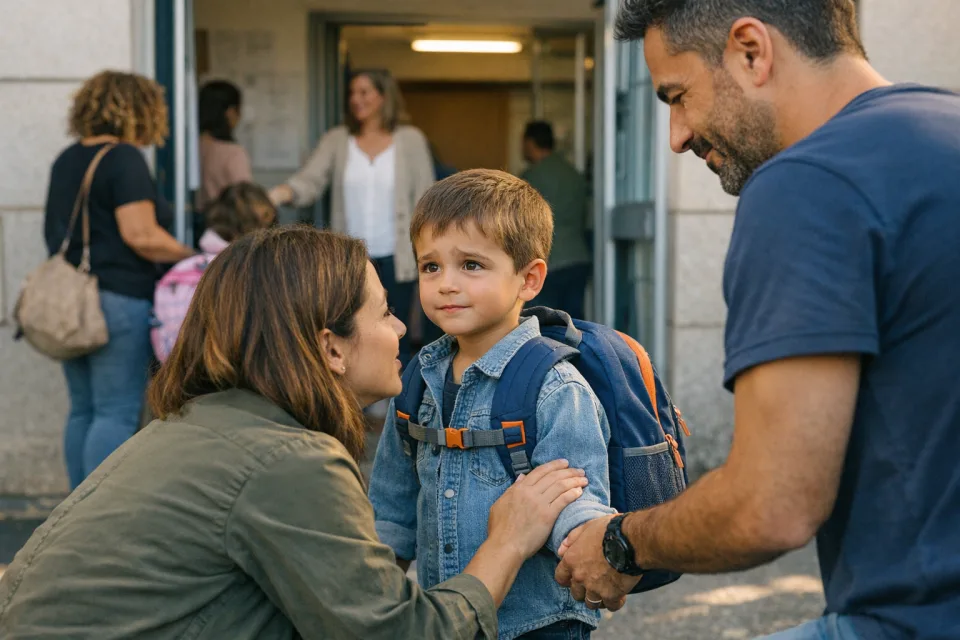
Short, clear goodbyes are usually more effective than hesitating for too long. When an adult stretches the moment out, asks for one more kiss again and again, or comes back several times, it can increase the child’s anxiety.
Some helpful phrases are:
- “I’ll come back after snack / at the end of the morning / at the end of the day.”
- “Your teacher will help you.”
- “If you miss me, you can hug your soft toy or talk to your teacher.”
- “I believe in you and I know you can do this.”
Your tone should be calm and firm. You do not need to act indifferent. Your child needs affection, but also reassurance.
What to avoid
Avoid slipping away secretly. Although it may seem easier in the moment, it can create mistrust and make future separations harder. Also avoid threats, comparisons or phrases like “if you cry, I’ll be sad” or “look, the other children don’t do that.”
If your child cries a lot
Crying on the first day is common and, by itself, is not a sign of a problem. Many children calm down a few minutes after their parents leave, especially when the teaching team is ready to welcome their emotions.
If the school allows it, follow the guidance given by the educator or teacher. In many cases, the best help is a brief, consistent goodbye, followed by a careful handover to a trusted adult.
If the school tells you that your child calmed down quickly, try not to see the initial crying as a failure. It is a normal reaction to a big change. What matters is how things evolve over the following days.
How to support adjustment during the first weeks
Adjustment rarely happens in one day. There may be progress and setbacks. One day your child may walk in easily; the next, they may cry again. That is normal.
Keep routines steady
Sleep, meals and leaving home at roughly the same times help children predict the day. In the early weeks, try to avoid unnecessary big changes. A child who is tired or hungry usually copes worse with separation.
Give time to both goodbye and reunion
At drop-off, keep it brief. At pick-up, offer presence, listening and calm. Many children need some time to let go of the tension built up during the day. There may be crying, tantrums or a lot of tiredness in the late afternoon. That does not mean adjustment is going badly.
Talk, but do not turn the day into an interrogation
Ask gently: “What was best about today?” or “Who did you play with?” Instead of asking lots of questions straight away, give your child space to share at their own pace.
Notice small wins
Did they walk in without crying? Great. Did they cry but then calm down? That is progress too. Did they play a little? Talk to a classmate? It all counts. Adjustment happens in small steps.
What if the goodbye is hard for parents too?
Many adults feel guilty, sad or afraid they are doing the wrong thing. This is especially common in families going through a recent change, such as a return to work, starting crèche, moving house or parental separation.
It can help to remember that school does not replace the family. It is an extension of care, a place where a child can learn, play and grow with other caring adults. The goal is not to “stop needing” parents, but to gain enough security to explore the world.
If you feel very emotional, it is worth taking a deep breath before going in, avoiding a long goodbye and trusting the school team. Children pick up a lot from their parents’ emotional state, even when nothing is said out loud.
When should you seek extra support?
Some adjustment period is normal, but it is worth asking for help if anxiety is very intense or lasts a long time, for example when:
- Your child continues to be very distressed for several weeks
- There is persistent refusal to go to school
- There is strong and prolonged regression
- There are frequent physical complaints with no medical explanation
- Your child shows intense separation fear in several settings
- There are major changes in sleep, eating or behaviour
In those cases, speak with the school and your paediatrician. If needed, support from a child psychologist may be helpful.
The school’s role in adjustment
Good adjustment also depends on how the school welcomes the child and the family. A team that is available to explain routines, welcome emotions and agree on strategies with parents makes a big difference.
If your child has specific needs, allergies, language difficulties, stronger anxiety or a history of difficult separations, it is worth sharing that information in advance. The more aligned family and school are, the safer the child is likely to feel.
Goodbyes that help children grow
Goodbyes are not always easy. But goodbye is also a learning moment. When children see that parents leave and return, and that strong feelings can be safe too, they build trust, independence and resilience.
The first day of school does not need to be perfect. It needs to be safe enough. With presence, routine and affection, most children find their place little by little.
And for many parents, the best news is this: the first day is only the beginning. After it come many more days, with more confidence, more familiarity and more calm.
Conclusion
Anxiety, adjustment and goodbyes are part of the first day of school for many families. Crying does not mean failure, and insecurity does not mean poor preparation. It simply means your child is going through an important change.
If you speak clearly, keep goodbyes short, maintain routines and trust the process, you are giving your child a solid base for this new step.