Homework is, for many families, one of the most stressful moments of the day. Between tiredness after school, lack of motivation, and the rush to get dinner ready, it is easy to wonder: how much should parents help?
The short answer is this: parents should help enough to support the child, but not so much that they do the work for them. Homework is not only about reaching the right answer. It is also about practising responsibility, organisation, persistence, and independence.
In practice, the right balance depends on the child’s age, maturity, the difficulty of the task, and even the type of homework set. Some children need more presence and guidance, while others only need a small push to get started. The important thing is that adult help does not replace the child’s effort.
What is the parents’ role in homework?
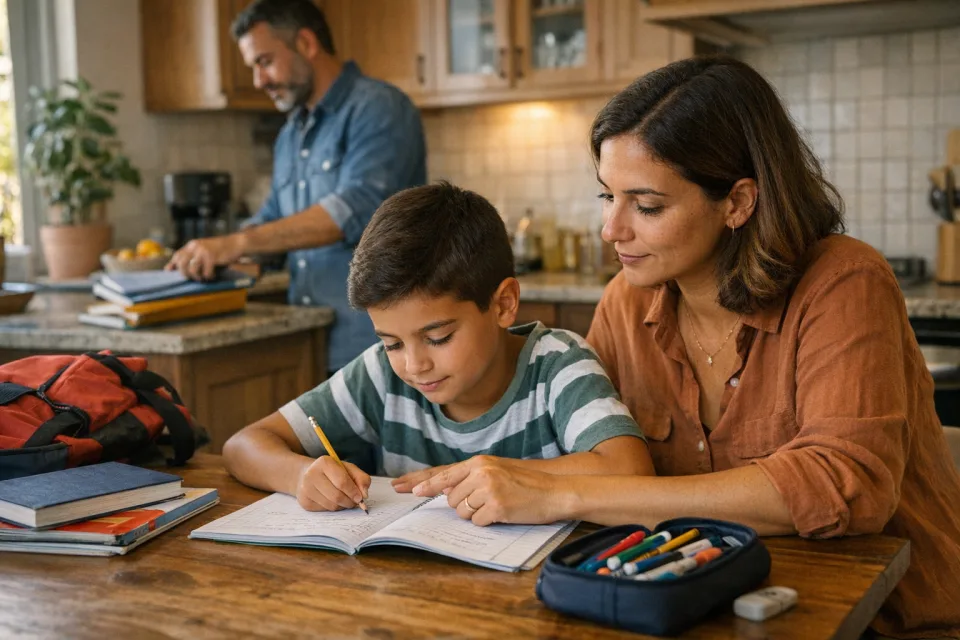
Parents are not meant to be the teacher at home. Nor are they meant to “disappear” and leave a child alone with a task they still do not have the tools to handle. The most helpful role is usually that of a guide.
This can mean:
- creating a routine and a suitable place to study;
- checking that the child understood what was asked;
- helping them get started;
- guiding them when they get stuck;
- encouraging without pushing too hard;
- reviewing the work at the end, if appropriate.
When parents take on this supportive role, the child feels accompanied while also learning to do more on their own.
How much help at each age?
There is no single rule for every family, but there are some general guidelines that can help.
In preschool and Year 1
At younger ages, it is normal to need more help. Children are still developing attention, coordination, understanding of instructions, and working habits.
At this stage, parents can:
- read the instructions aloud;
- explain what needs to be done in simple words;
- break the task into small steps;
- stay closer and supervise more directly;
- praise effort, not just the result.
Even so, it is worth resisting the temptation to complete the activity for the child. If they write a crooked letter, erase several times, or need more time, that is part of learning.
In primary school
As children move through primary school, the goal is to do more with less help. Parents can stay nearby, but it helps to encourage independent trying before stepping in.
A good strategy is to ask:
- “What do you need to do first?”
- “What is the hardest part?”
- “Do you want me to read the question with you?”
These questions help children think, instead of immediately depending on the adult’s answer.
In lower and upper secondary school
As school demands more organisation, homework also becomes a way to practise responsibility. At this stage, many parents need to step back a little and focus more on time management than on the content itself.
It can help to:
- agree on a fixed study time;
- check whether there are tests or important assignments;
- help break long tasks into parts;
- make sure the necessary materials are ready;
- discuss strategies rather than giving answers.
If a teenager still asks for a lot of help, it does not necessarily mean laziness. It may reflect insecurity, learning difficulties, anxiety, or underdeveloped study habits.
In upper secondary school
In upper secondary school, help should become increasingly indirect. Ideally, the young person takes most of the responsibility, with parents acting as emotional and organisational support.
Instead of monitoring everything, it may be more effective to:
- make yourself available for occasional questions;
- help plan study periods;
- keep a stable home routine;
- recognise effort and independence;
- notice signs of overload.
If there is a sudden drop in performance, it is worth talking to understand whether there is tiredness, stress, learning difficulties, or wellbeing issues.
When is help useful, and when does it get in the way?
Help is useful when it makes the child more capable. Help gets in the way when the child becomes dependent on the adult to finish any task.
Useful help:
- explaining instructions;
- giving an example;
- asking guiding questions;
- breaking a big task into smaller parts;
- giving constructive feedback.
Help that can get in the way:
- doing every exercise for the child;
- giving answers without letting them think;
- redoing work so it looks “perfect”;
- correcting everything excessively;
- using homework as a reason for constant criticism.
When parents do too much, children learn less and may start to believe they cannot do things on their own. That weakens confidence and can increase resistance to homework.
How can you help without doing it for your child?
There are several practical ways to support a child while preserving independence.
1. Create a predictable routine
Children usually respond better when they know what to expect. It can help to set a fixed homework time, ideally after a short break and before they become too tired.
2. Prepare the environment
A quiet place, with few screens and materials within reach, makes a difference. It does not need to be perfect, but it should be functional.
3. Start with the easiest part
Sometimes the biggest obstacle is simply getting started. A small bit of help to begin can reduce resistance.
4. Ask questions, do not jump straight to solutions
Questions like “What is being asked here?” or “How could you solve this?” help children think and build independence.
5. Accept that mistakes are part of learning
Making mistakes is part of learning. If adults correct everything immediately, children lose the chance to learn from their own errors.
6. Praise effort
Phrases like “I liked how you tried on your own” or “You kept going” value the process, not just the final grade.
What if your child does not want to do homework?
Resistance is very common. It is not always stubbornness. Often, a child is tired, bored, insecure, or simply distracted.
In those moments, it helps to stay calm and avoid power struggles. Some useful strategies:
- give a short break before starting;
- break the work into short blocks;
- use a timer;
- offer limited choices, such as “Do you want to start with maths or English?”;
- agree on clear, consistent consequences, without shouting or humiliation.
If refusal is frequent, intense, or linked to crying, stomach aches, anxiety, or daily conflict, there may be something deeper going on. In that case, it is worth looking at whether the difficulty is with the task, school, tiredness, or the child’s emotional wellbeing.
What if parents feel they have to “watch everything”?
Some parents feel that if they are not constantly on top of things, their child will do nothing. This can happen for many reasons: inconsistent habits, difficulty getting started, fear of failure, or even slower learning.
In these cases, it may help to move from constant watching to gradual supervision:
- support more at the beginning;
- reduce help little by little;
- agree on small goals;
- observe what the child can already do alone;
- keep rules stable, without changing them every day.
If a child only works when an adult is beside them, they may need to learn self-regulation skills. That takes time and practice.
Should homework always be done as a family?
No. In many situations, children need some independence to build confidence. Being alone does not mean being abandoned. It can mean, for example, doing one simple exercise first and calling an adult only if a real question comes up.
At the same time, some children benefit from closer support, especially if they have attention, reading, writing, organisation difficulties, or additional educational needs. In those cases, coordination with the school is especially important.
When should you ask the school for help?
If homework is causing frequent distress, it is worth speaking with the class teacher, tutor, or another school professional.
Seek support if you notice:
- excessive time spent every day on simple tasks;
- a lot of frustration or crying;
- performance far below expectations;
- persistent refusal to study;
- signs of anxiety or low self-esteem;
- difficulties that seem to go beyond lack of effort.
A conversation with the school can help adjust expectations, clarify the recommended support, and determine whether further assessment is needed.
How can you keep the relationship positive?
Homework should not become a daily battlefield. When it does, the relationship between parents and children can become strained.
Some ideas to protect the bond:
- separate study time from affection time;
- do not use homework as punishment;
- do not compare your child with siblings or classmates;
- take a break when tension rises;
- end on an encouraging note.
The main message should be: “I am here to help you learn,” not “I only like you when you meet my expectations.”
In short
Parents should help with homework, but in a balanced way. The best help is the kind that promotes independence, confidence, and responsibility. At younger ages, adult presence is more necessary; as children grow, help should become more discreet and focused on organisation and emotional support.
If homework is causing constant stress, conflict, or distress, that is not a sign of family failure. It may be a sign that something needs adjusting, whether it is the routine, the strategy, or support from the school.
The final goal is not perfect homework. It is to raise children and young people who can learn, think, and trust their own abilities.
About the sources
This article is for general informational purposes and does not replace guidance from your child’s school or qualified professionals when specific concerns arise.