
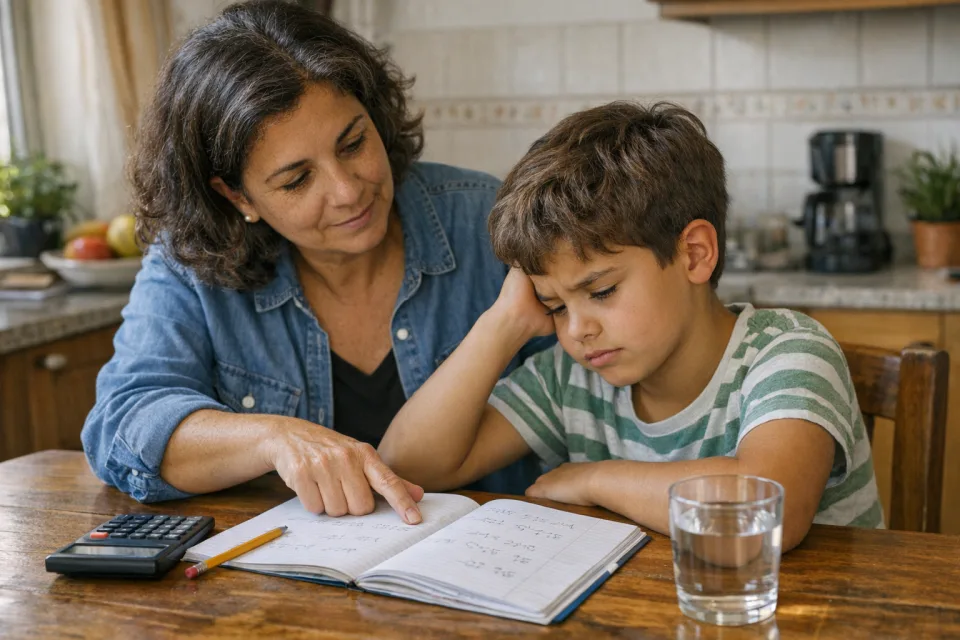
When math stops being just another subject
For many children and teenagers, math stops being just a school subject and becomes a source of tension. Just opening the notebook can trigger phrases like “I can’t do this,” “this is impossible,” or “I’m going to fail.” At that point, the problem is no longer only academic. It is also emotional.
It is very common for parents to feel the urge to correct, push, or repeat that “it’s just practice.” But when a child is already struggling, pressure can increase the block. The goal is not to remove the challenge from math, but to help rebuild confidence, curiosity, and the ability to learn without fear.
This article focuses on practical strategies to support children at home, without turning study time into a battle.
Why does anxiety show up in math?
Anxiety can appear for many reasons. Sometimes a child has had a negative experience, such as a bad grade, a stricter teacher, or embarrassment about making a mistake in front of classmates. Other times, difficulties build up and the child starts to feel that they “just aren’t cut out for it.”
There are also children who need more time to consolidate concepts, or who learn better with concrete examples than with abstract explanations. When the pace of the lesson is fast, they may fall behind without that meaning they are not intelligent or not trying.
In addition, math requires several skills at once: working memory, attention, reading comprehension, logic, and persistence. If one of these areas is weaker, the subject can seem much harder than it really is.
Signs that the difficulty is becoming emotionally heavy
Some children say directly that they are afraid of math. Others show their distress in indirect ways. It is worth watching for signs such as:
- putting off anything related to math;
- crying, getting angry, or giving up quickly;
- saying they are “stupid” or “can’t do it”;
- having stomach aches, headaches, or nausea before tests;
- tantrums or shutting down when the subject is mentioned;
- depending heavily on an adult to start or continue studying.
If these signs happen often, emotional support is just as important as academic support.
What parents can do at home
1. Start with the relationship, not the correction
Before solving exercises, try to understand how your child is experiencing the situation. Phrases like “I can see this is hard for you” or “let’s figure out together where it became difficult” help more than “that’s easy” or “you should already know this.”
The child needs to feel that the adult is on their side, not evaluating them.
2. Lower the pressure in the moment
If a child is panicking, studying for longer usually does not help. Sometimes it is better to stop, breathe, drink some water, and come back with a small goal. For example: solve just two exercises, identify the type of calculation, or review one rule at a time.
The brain learns better when it feels safe. Without that, memory and attention are affected.
3. Replace “I don’t understand anything” with concrete steps
Help the child name the problem. Instead of “I don’t understand anything,” you can ask: “Is it the word problem?”, “Is it the calculation?”, “Is it knowing where to start?”, or “Are you tired?” Often the difficulty gets smaller when it is broken into parts.
This clarification avoids vague arguments and makes it easier to find a solution.
4. Use everyday examples
Math becomes more meaningful when it leaves the page. Cooking, measuring ingredients, counting change, reading the time, splitting a pizza, organizing schedules, or comparing prices are simple ways to practice without it feeling like an extra lesson.
For some children, handling objects, drawing diagrams, or using blocks helps much more than working only with abstract numbers.
5. Praise the process, not just the result
Instead of praising only the grade, highlight specific effort: “I liked how you separated the information in the problem,” “you tried again even after making a mistake,” or “you explained your thinking more calmly this time.” This reinforces the idea of progress.
If a child feels that only getting the answer right matters, they will fear every mistake. If they understand that learning includes failing and correcting, they build more emotional resilience.
What to avoid so you don’t increase anxiety
Even with good intentions, some phrases and attitudes can make the block worse. Try to avoid:
- comparing them with siblings, classmates, or “when I was your age”;
- threats like “if you don’t improve, you’ll have serious problems”;
- turning study time into a daily confrontation;
- doing everything for your child without letting them think;
- correcting every step impatiently;
- using sarcasm, irony, or shame as motivation.
It is also important not to turn a difficulty into an identity. Saying “you’re terrible at math” is much heavier than “math is difficult for you right now.” The first sentence sticks to self-esteem; the second leaves room for change.
How to help them study more effectively
Keep study sessions short
Instead of long stretches, try short blocks with breaks. Many children concentrate better in 15 to 25 minutes of focused work, followed by 5 minutes of rest.
After each block, it helps to set the next step clearly. Predictability reduces anxiety.
Review the lesson before doing exercises
If a child is practicing fractions, for example, they can start by reviewing what numerator and denominator mean, looking at a solved example, and only then moving on to simple exercises. Skipping this step can increase confusion.
Start with the easiest tasks
When confidence is low, it makes sense to begin with tasks the child can do with minimal help. Early success helps unblock them. Then the difficulty can be increased gradually.
Let the child explain out loud
Talking through the reasoning helps organize thought. Even if the explanation is not perfect, the child becomes more aware of where the difficulty is. The adult can ask short questions: “What do you know?”, “What are they asking?”, “What is the first step?”
When it is important to talk to the school
If the difficulty is persistent, it is worth speaking with the class teacher, form tutor, or math teacher. The school can help figure out whether the problem is more temporary or whether there are signs of a broader learning difficulty.
In Portugal, educational support measures should be considered in coordination with the school and, when necessary, with other professionals. The goal is to adapt the response to the child’s needs, not simply demand more effort.
It can help to share concrete examples: blank tests, anxiety before assignments, difficulty reading word problems, or trouble memorizing procedures. The more specific the information, the better the school can respond.
When to look for extra support
If the difficulty is very large, if anxiety is frequent, or if there are signs of intense demotivation, it may be useful to seek support outside the home. This may include tutoring with someone who teaches calmly, psychoeducational support, or an assessment by a professional when there is suspicion of a specific difficulty.
It is also important to seek help if the child starts avoiding school, becomes extremely afraid of tests, or visibly loses self-esteem. The earlier action is taken, the better for both well-being and learning.
In some cases, difficulty in math may be linked to a specific learning disorder with impairment in mathematics, but only an appropriate assessment can clarify that. It is not worth jumping to that conclusion based on low grades alone.
How to talk to your child after a bad grade
After a poor test result, a child needs reassurance more than a lecture. You can start by acknowledging the effort and frustration: “I know this was hard for you and that you’re disappointed.” Then it helps to ask short, concrete questions: “What went wrong?”, “Where did you get lost?”, “What can we change next time?”
If the adult reacts with shock or deep disappointment, the child learns to hide mistakes. If the reaction is calm, the child learns to analyze them.
What if the anxiety comes from the parents?
It is natural for parents to feel afraid when they see their child struggling. However, when adult anxiety rises too much, children usually feel that tension and amplify it. Try to notice your own tone, the words you use, and the expectations you communicate.
If you find yourself pushing too hard, pause. The main message should be: “we’ll find a way to help you.” Not: “this has to be fixed right now.”
Small steps that make a difference
Change is not always quick. Still, a few small actions can bring relief:
- having a quieter, more predictable place to study;
- setting a fixed routine for math;
- celebrating every bit of progress, even small ones;
- accepting that the child may need more time;
- staying in contact with the school;
- asking for help when the atmosphere at home is already too tense.
The goal is not to create a perfect student. It is to help a child feel that they can learn without fear and without shame.
Conclusion
Math difficulties can affect confidence, motivation, and even a child’s relationship with school. But the way adults respond makes a big difference. When support is calm, concrete, and respectful, children feel safer to try, make mistakes, and try again.
Instead of increasing pressure, try to reduce emotional noise. Focus on small steps, encouraging language, routine, collaboration with the school, and valuing progress. Often, that is what gives a child back the ability to learn.
If anxiety is intense or persistent, it is worth seeking specialized support. That is not a sign of failure. It is a responsible way to care for both learning and well-being.
FAQ
How do I help a child who says they are bad at math?
Do not agree with that label. Instead, say that math is difficult right now and that it can improve with support, strategy, and time.
Should I force my child to do lots of exercises?
More exercises do not always mean better learning. If anxiety is present, too much can increase the block. Often, it is more effective to do less, but with more understanding and calm.
When should I seek professional help?
If the difficulty is persistent, if the child becomes very anxious, or if self-esteem is affected, it may help to contact the school and, if necessary, a specialized professional.
Is it normal for a child to cry because of math?
It can happen, especially when there is a fear of making mistakes or repeated experiences of frustration. If it happens often, it is important to look at the emotional side, not only the grades.
How can I help without doing the work for my child?
Ask questions, help organize the reasoning, and give hints. The ideal is to support thinking, without replacing the child’s effort.
Useful sources
For educational support and official guidance in Portugal, consult the information from the Directorate-General for Education and the Directorate-General of Health. If there is a suspicion of a learning difficulty or significant anxiety, the school and health professionals can guide the next steps.