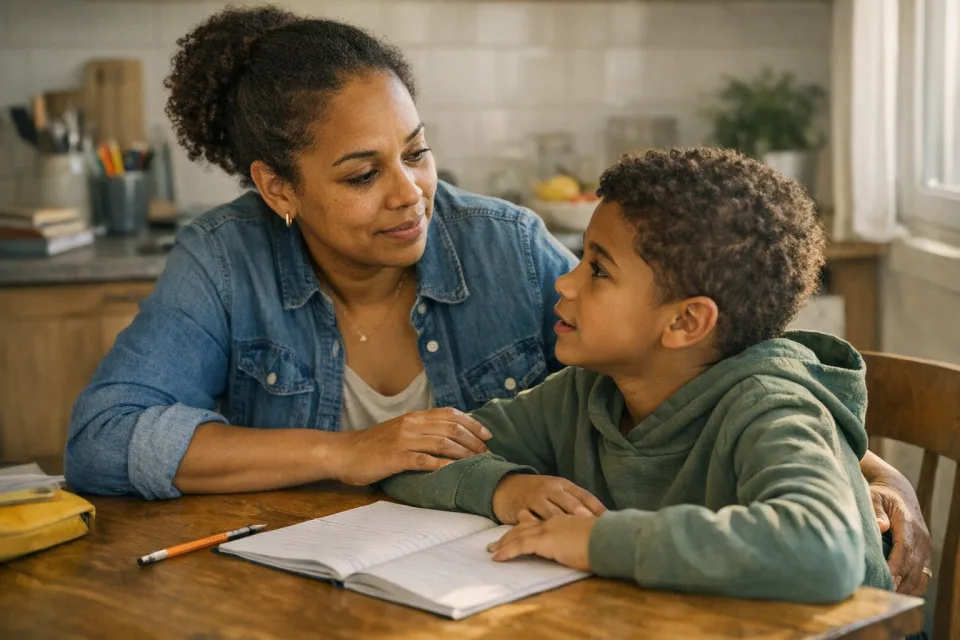
When a child says “I’m stupid”, the most important thing is not to panic. Even if the sentence hurts to hear, it is usually less a truth about the child and more a sign of frustration, shame, tiredness, or fear of failing. The way an adult responds can help turn that moment into a step in learning rather than a mark on self-esteem.
Many parents and caregivers feel the urge to correct the phrase right away, say “don’t say that”, or respond with rushed reassurance. But in general, what the child needs first is to be seen, calmed, and helped to name what they are feeling. Only then does it make sense to talk about effort, mistakes, and confidence.
Why does a child say “I’m stupid”?
Children rarely use this expression with the same weight an adult gives it. Often they are trying to say:
- “I couldn’t do it.”
- “I feel ashamed.”
- “I feel worse than the others.”
- “I’m afraid of failing again.”
- “I wish you would help me.”
This phrase may appear after a bad grade, a difficult task, being compared with siblings or classmates, or even after a telling-off. In younger children, it often comes out in the heat of the moment. In school-age children, it may start to reveal a more fixed way of seeing themselves. In that stage, it is worth paying attention to the pattern, not just the isolated phrase.
What does not help to say in the moment
There are well-meant replies that end up closing the conversation or increasing shame. Common examples include:
- “Don’t be silly.”
- “Of course you’re not stupid, you’re very smart.”
- “So now you’re insulting yourself?”
- “Look at your classmates, they can do it.”
- “If you keep this up, you’ll never learn.”
These phrases may sound harmless, but they often leave the child alone with the emotion. Saying only “you’re smart” may also not be enough, because the child may think: “If I’m smart, why did I fail?” Instead of correcting quickly, it is better to listen and guide.
How to respond without making a drama out of it
The idea is not to give a big speech. It is to respond calmly, in a few words, and show that the mistake does not define the child.
1. Acknowledge the emotion
Start by recognising what the child is feeling:
- “I can see you’re frustrated.”
- “That didn’t go well, and that’s upsetting.”
- “You’re really angry with yourself, aren’t you?”
- “You’re feeling low because of this.”
When the emotion is named, shame becomes less intense and there is room for conversation.
2. Separate the person from the mistake
A useful reminder is that doing one thing badly does not mean being incapable:
- “You didn’t manage this one this time, but that doesn’t say who you are.”
- “You haven’t learned this part yet.”
- “You got this sum wrong; you are not your sum.”
- “You’re learning, and learning includes getting things wrong sometimes.”
This kind of language is more effective than vague praise, because it teaches the child to think about the process, not about a label.
3. Offer one concrete next step
Once the child is calmer, help them move forward:
- “Do you want me to show you another way?”
- “Let’s do this together, step by step.”
- “Would you rather try again or take a short break?”
- “Where did you get stuck?”
When a child feels there is a solution, the phrase “I’m stupid” loses strength.
Helpful phrases to keep in mind
It helps to have a few simple responses ready. For example:
- “You’re not stupid. You’re frustrated.”
- “No one learns everything on the first try.”
- “This exercise is hard, but we can break it into smaller parts.”
- “A mistake is not the same as being incapable.”
- “I believe you can learn this with time.”
If the child is very upset, less is more. Sometimes one short sentence, said calmly, is worth more than a long explanation.
What to do if the child compares themselves to others a lot
Constant comparisons with siblings, classmates, or cousins can feed this sense of being inferior. The child starts to believe their worth depends on being the best, or at least on never failing. When that happens, it helps to shift the focus.
Instead of comparing, highlight progress:
- “Today you did part of it on your own, that’s progress.”
- “Yesterday you needed help with everything; today you already started on your own.”
- “It wasn’t perfect, but you learned something new.”
It also helps to avoid labels like “the smart one”, “the distracted one”, or “the lazy one”. Children tend to hold on to these tags and build their identity around them.
When the phrase may be hiding something else
If “I’m stupid” appears often, especially along with giving up, frequent crying, irritability, fear of school, or refusing to try, there may be more going on than a bad moment. For example:
- learning difficulties
- attention problems
- performance anxiety
- ongoing low self-esteem
- perfectionism
- teasing or humiliation at school
In those cases, it is worth watching carefully: when the phrase appears, how often, and whether the child is avoiding tasks they used to accept. If it is affecting school, mood, or behaviour, it may help to speak with the teacher, the school psychologist, or the child’s paediatrician.
How to help build healthier language
Children learn a lot from the way adults speak about themselves. If a parent or caregiver often says “I’m a disaster”, “I’m terrible at this”, or “I never get anything right”, the child may copy that thinking style.
So try to model more realistic language:
- “This was hard for me, but I’ll try again.”
- “I made a mistake, it happens.”
- “I’m still learning.”
- “It didn’t go well, but I can improve.”
Without lecturing, the child learns that failing is part of life and not a reason to put themselves down.
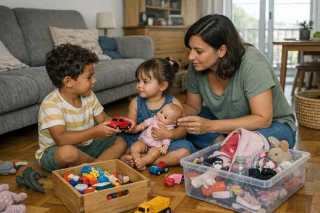
If the child is younger
With younger children, the key is to make the concrete situation easier to handle. Instead of talking about “intelligence” or “ability”, focus on the task.
- “This puzzle is hard.”
- “You haven’t fitted this piece yet.”
- “Let’s try again.”
It can also help to use games, stories, and play to show that making mistakes is part of learning. Young children understand simple examples much better than abstract explanations.
If the child is older
At school age and in the teenage years, the phrase may come with deeper shame. At this stage, it matters to talk without infantilising them and without giving a lecture.
You could say something like:
- “I know this is affecting you.”
- “I can understand why you feel that way when things go badly.”
- “Let’s look at what is making you feel unable to do it.”
Teenagers tend to reject very long speeches, but they usually respond better when they feel respected and when the adult does not humiliate them or overreact.
When to seek help
It is advisable to seek support if the child:
- puts themselves down frequently
- always avoids tasks for fear of making mistakes
- has ongoing mood changes
- shows signs of anxiety or prolonged sadness
- often says they are “stupid”, “bad”, or “useless”
- starts refusing school or loses interest in things they used to enjoy
You do not need to wait for a crisis. The sooner you understand what is behind the phrase, the easier it is to help.
The main thing to remember
When a child says “I’m stupid”, they do not need a heavy reaction or a rushed correction. They need a calm adult who helps separate mistake from identity and shows that learning takes time.
A good response usually has three parts: acknowledge, name, and guide. Acknowledge the emotion, name the frustration, and guide the child toward the next step. It is simple, but very powerful.
Over time, these small responses teach the child to think: “I failed this time, but I can still learn.” And that is a much stronger foundation than any label.