
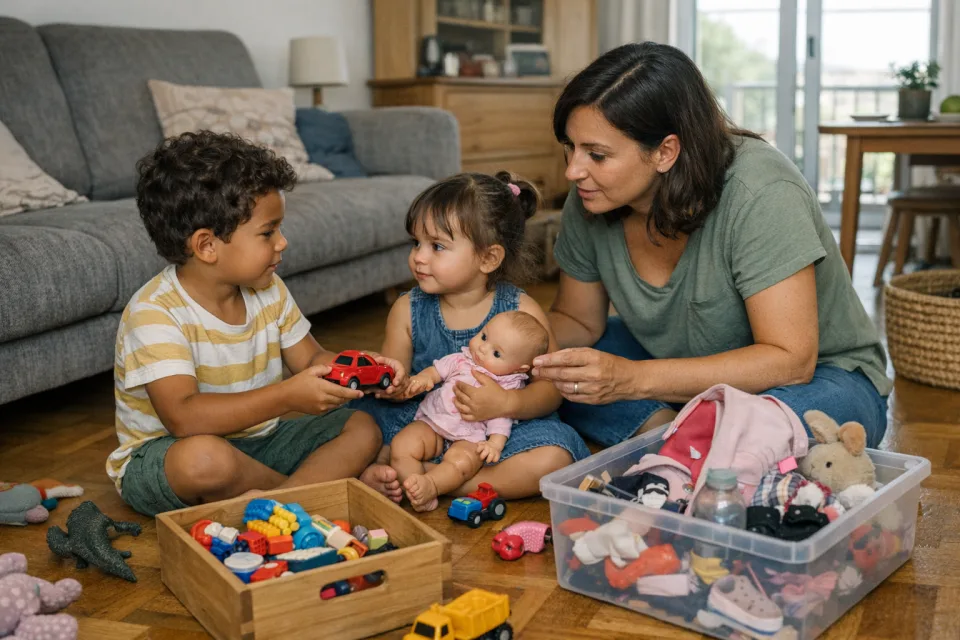
“You have to share!” is a very common phrase in homes, playgrounds, and preschool classrooms. And it makes sense to want children to learn how to live with others, take turns, and negotiate. But there is an important point: sharing toys is not something you can teach by force. When children are made to give everything up, what they often learn is not generosity, but frustration, fear of losing, and a sense of unfairness.
Sharing is a social skill that develops over time. It depends on age, temperament, developmental stage, and the context. A young child may still not be mature enough to fully understand what it means to lend, exchange, or wait. So the goal should not be “always share,” but rather learning how to live with rules, limits, and respect for others.
What sharing really means
Sharing does not mean handing over everything all the time. For a child, it can mean different things: lending a toy for a few minutes, playing together, taking turns, dividing materials, or even accepting that some objects are personal and do not need to be handed over.
In real life, adults do not share everything either. We have personal belongings, preferences, and moments when we simply do not feel like giving in. Teaching a child to share is not about making them always say “yes,” but helping them recognize the right time to negotiate, the right time to wait, and the right time to say “no.”
Why it is so hard for young children
Between ages 2 and 5, many children are in a stage where their sense of ownership is becoming very strong: “It’s mine.” This is not selfishness in the adult sense of the word. It is development. The child is still learning that others also have wants, that toys can be used by more than one person, and that waiting is part of play.
In addition, favorite toys have a strong emotional value. If a child is tired, hungry, overstimulated, or insecure, their ability to share drops even more. In those moments, insisting can increase tantrums and conflict.
What parents can do instead of forcing it
There are many ways to teach sharing without turning everything into a battle. The key is to guide, model, and create structure.
1. Start by respecting personal items
If a toy is special, new, or much loved, it is not a good idea to demand that the child hand it over to another child right away. That toy can be kept for safe play at home or for moments when the child is ready.
A helpful phrase is: “That is your special toy. You do not have to lend it if you do not want to. We can choose another one to share.”
2. Teach the difference between lending, trading, and playing together
Not every situation calls for the same kind of sharing. Sometimes the goal is parallel play; other times, taking turns; and in other moments, lending an item for a short time. Children learn better when they understand what is happening.
For example: “You can have the car for five minutes, and then it goes to your brother.” Or: “With this modeling clay, you can both play at the same time.”
3. Lead by example
Children learn a lot from what they see. If adults ask for respect but do not respect the child’s boundaries, the message loses strength. When parents share voluntarily and explain what they are doing, they help the child understand that sharing is a social choice, not an imposed rule.
You can say: “I’m lending my book to grandma because I know she really likes reading. Then it comes back to me.”
4. Set simple agreements before playtime
Before receiving a visitor or going to a place with other children, it helps a lot to agree on the rules in advance. Instead of solving everything in the middle of a conflict, say beforehand: “Today the toys will be used by everyone, but some will be kept aside.”
Having one box of toys to share and another with personal toys can reduce many arguments.
5. Help the child wait and take turns
Waiting is not easy for young children. That is why the adult can make waiting concrete. A timer, a short song, or counting helps the child understand when their turn comes.
It is also useful to give language to the situation: “Now it’s your friend’s turn. Then it will be yours.” If the child manages to wait, recognize the effort: “You managed to wait, that was really hard and you did very well.”
6. Name the feelings
Many tantrums happen because the child feels they have lost control. When the adult names what is happening, the child feels understood. Saying “You are angry because you wanted to keep playing with the toy” helps more than “Don’t cry” or “Don’t be selfish.”
Validating the feeling does not mean accepting hitting, pushing, or shouting. It means showing that the emotion makes sense, even when the behavior needs a limit.
When a child really does not want to share
There are days when the answer will be “no.” And that can be normal. There is no need to turn every refusal into a power struggle. The adult can teach the child to say no respectfully while also protecting life together between siblings, cousins, or friends.
One possible response is: “I understand you do not want to lend that toy. Let’s put it away and choose another one.” If another child is involved, you can say: “Right now he does not want to share that toy. Let’s find another one to play with while he waits.”
The goal is to show that the child’s feelings matter, but that living together also has rules.
Common mistakes that make learning harder
Some well-intentioned actions end up making sharing harder for the child.
Forcing them to give in every time can make a child feel they have no right to anything.
Calling names, such as “selfish” or “bad-mannered,” hurts self-esteem and does not teach a concrete skill.
Intervening too late allows conflict to escalate into aggression.
Expecting maturity beyond the child’s age creates unrealistic expectations.
Over-rewarding or over-punishing can make a child share only to please adults, without understanding the value of cooperation.
Children learn sharing better through repetition, patience, and consistency than through long lectures.
How to adapt by age
Up to age 2: the idea of sharing is still very limited. The adult needs to mediate almost everything and protect the use of the most sensitive objects.
From ages 2 to 4: ownership is often very strong. In this stage, short turns, alternatives, and not expecting too much spontaneous generosity work better.
From ages 5 to 7: the child can better understand taking turns, agreements, and fairness. They can take part more in deciding how to share.
From then on: sharing can also be worked on as empathy, cooperation, and responsibility. The child begins to understand that sharing can strengthen friendships and make play richer.
And when there are siblings?
Between siblings, sharing becomes a bigger issue because conflicts are frequent and comparison is also part of the picture. Here it is important to avoid the idea that everything must be communal. Not everything that belongs to one sibling should be used by the other without permission.
Having some protected personal items can reduce arguments. At the same time, it is worth teaching that there are toys and materials in the home that are meant to be shared. The balance between what belongs to each child and what belongs to everyone helps build mutual respect.
It is also important not to always force the older child to give in “because they are bigger,” or to expect the younger child to follow rules they still do not understand. Fairness between siblings is not about treating everyone exactly the same in everything, but giving each child what they need at that stage.
At school and in preschool
In school settings, sharing is part of group life. Teachers and educators help a lot when they organize activities with enough materials, clear turns, and simple rules. If there is not enough to go around, conflicts increase.
Adults can reinforce phrases like: “We can use this material in turns” or “Let’s see how we can cooperate to build this together.” School is also a great place to learn that there are individual and group games, and that both are important.
When the difficulty is greater than expected
If a child has a lot of difficulty waiting, handling frustration, or accepting any kind of turn-taking, it may be worth looking at the broader context. Tiredness, family changes, anxiety, sensory needs, communication difficulties, or periods of higher stress can all have a strong influence.
If conflicts are very intense, frequent, or accompanied by aggression, it makes sense to speak with the pediatrician, educator, or child psychologist. Sometimes difficulty sharing is just a phase. In other situations, there may be additional support needs.
Phrases that help
Some simple phrases can make a big difference:
- “Your friend first, then you.”
- “That toy is special. You can choose another one to lend.”
- “I understand that you are angry.”
- “Let’s find a solution that works for both of you.”
- “You can say: not now, but maybe later.”
- “Sharing is hard sometimes, but you are learning.”
What we really want to teach
More than creating a child who hands everything over without complaint, the goal is to raise someone who can live with others: respect, negotiate, wait, cooperate, and also defend their own boundaries politely. That matters in childhood, but also in adolescence and adult life.
Teaching children to share toys is, at its core, teaching them how to live together. And that works better with calm firmness than with pressure. When the child understands that their feelings are respected and that there are clear rules, it becomes easier to learn how to share in a genuine way.
If today they do not want to lend the car, that does not mean they have failed. It only means they are learning. And learning takes time.
Conclusion
Sharing toys should not be an automatic demand or a test of “good manners” measured by obedience. It should be a gradual learning process, adapted to age and context, with boundaries, examples, and a lot of patience. Instead of forcing everything, the most useful thing is to teach the child to wait, negotiate, respect, and cooperate. That way, sharing stops being an imposition and becomes a real life skill.