Sometimes, what makes the biggest difference is what seems the simplest
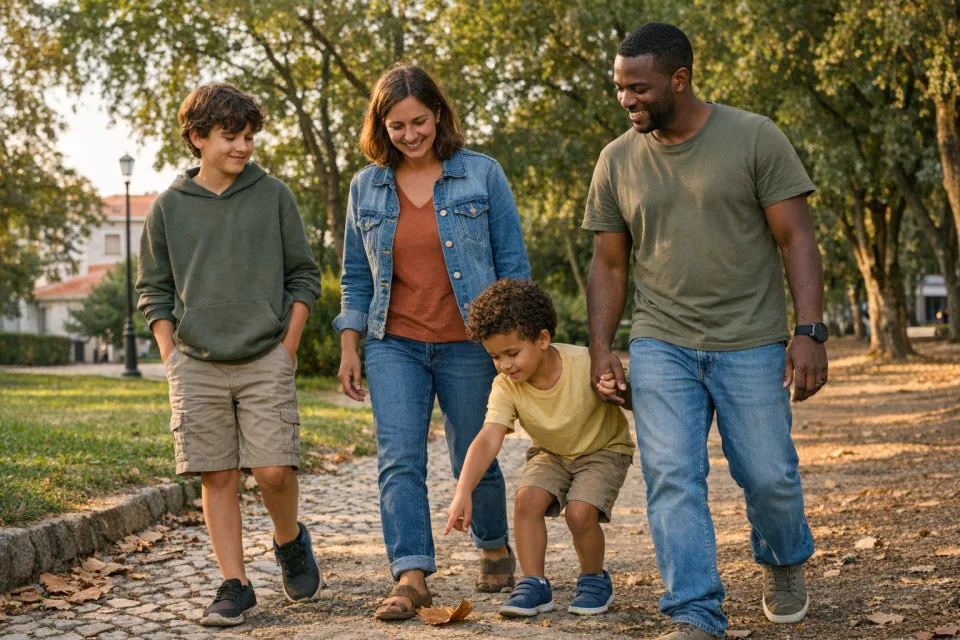
In the middle of busy schedules, meals, screens and constant rushing, it is easy to think that family wellbeing needs something big: a special activity, an expensive outing, a major routine change. But often, a simple walk outdoors already brings very concrete benefits for children and adults.
Leaving the house, even for 15 or 20 minutes, can help regulate emotions, burn off energy, calm arguments, improve sleep and bring a bit of lightness back into the day. For many families, this small habit becomes a point of balance between chaos and calm.
This article explains why a walk outdoors can be so powerful and how to adapt it to your children’s ages, your family routine and even the harder days.
Why being outdoors helps
The body and mind respond to the environment. When a child spends too much time indoors, especially with little movement, tension, irritability and mental fatigue tend to build up. The same happens to adults. Being outdoors helps break that cycle.
There are several reasons for this:
- More movement: walking, running, climbing, going up and down and exploring help release energy.
- Fewer artificial stimuli: stepping away from screens, noise and rushing can calm the nervous system.
- Natural light: daylight exposure helps regulate the body clock and may improve sleep.
- Contact with nature: trees, sky, grass, water or simply a change of scenery can reduce the feeling of overload.
- Space to talk: walking side by side often makes spontaneous conversation easier than sitting face to face in the middle of a disagreement.
Even if the walk is short and simple, the change of environment already has an impact.
Benefits for children
For babies, toddlers and school-age children, a walk outdoors can be much more than “going out to burn energy”. It is also a chance to support development.
1. It helps regulate emotions
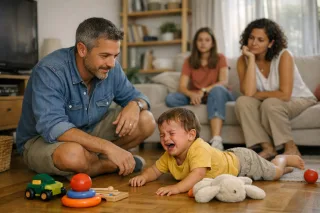
Many children still do not know how to explain what they feel. When they are frustrated, tired or overstimulated, they may cry, have tantrums or refuse instructions. A walk can help lower emotional intensity without requiring a long conversation.
Instead of insisting only on talking, movement and fresh air can give the child space to regain balance. Often, after walking a little, the child is more willing to listen, eat, play or return to the task.
2. It encourages curiosity and learning
Observation, questions, discovery and language all happen naturally on a walk. A child notices animals, colours, sounds, smells, people and objects. This stimulates attention and vocabulary in an effortless way.
There is no need to turn the walk into a lesson. Simply allowing the child to look and comment is enough. A walk can be a small educational adventure.
3. It supports motor development
Going up a pavement, jumping over a small obstacle, balancing on a kerb, crouching down to look at a flower or running after a ball are all important experiences for coordination, balance and strength.
For younger children, walking on different surfaces is a chance to explore their body and the space around them. For older children, it is a simple way to keep moving on a day filled with school and tasks.
4. It may improve sleep
When a child spends the whole day indoors in highly stimulating environments, they may still feel “switched on” at night. Natural light and movement help the body better recognise when it is daytime and when it is time to rest.
Of course, a walk does not solve sleep problems on its own, but it can be an important support in a more stable routine.
Benefits for parents and caregivers
A walk outdoors does not only benefit children. Often, the person doing the caring needs that break too.
Less tension, more presence
When adults are overloaded, small conflicts can feel much bigger. Leaving the house can work as an emotional pause. Even if it does not solve everything, it can help you come back with more patience and clarity.
Sometimes, a walk is enough to interrupt an argument that was getting worse. Not as an escape, but because the body needs to step away from the pressure of the moment.
A moment of connection
It is not always easy to have deep conversations at home, with chores and distractions all around. Outside, the pace slows down. That makes simple questions easier, such as: “How was your day?”, “What was the hardest part today?”, “What made you laugh?”
For many families, the walk becomes a connection ritual. It does not need to be long or perfect. What matters is being present.
When a walk helps most
There are times when a short walk can make a special difference:
- after school or nursery;
- before dinner, to help release energy;
- when a child is irritable or overly agitated;
- on emotionally heavy days, when the family feels stuck and impatient;
- at the weekend, to break the feeling of “the same day on repeat”.
It can also help during times of change, such as starting school, the birth of a sibling, parental separation or periods of higher anxiety.
How to turn a simple walk into a useful habit
You do not need big plans. The key is regularity and simplicity.
Start small
If your family is not used to it, starting with 10 minutes is enough. The goal is not to reach a perfect target, but to build a realistic routine.
Choose a predictable time
Some families prefer to go out after dinner, others in the late afternoon, others on Sunday morning. The best time is the one that fits real life.
Take the pressure off the walk
It does not need to be an educational experience or a “productive” walk. If the child stops to look at stones, leaves or dogs, that is part of it too.
Take fewer things
The simpler the outing, the more likely it is to happen. A coat, comfortable shoes and water may be enough.
Use the walk to slow down
If there are phones around, try to reduce use during that time. A walk has more value when you are paying real attention to what you see, hear and feel.
Walk ideas for different ages
Babies
With babies, the walk can be in a buggy, in your arms or in a suitable sling/carrier. What matters is changing the environment, letting the baby see natural light and hear sounds different from those at home.
Ages 2 to 5
At this age, children enjoy observing and repeating. You can look for leaves, play “who sees it first”, jump on lines drawn on the ground or simply walk without rushing.
Ages 6 to 10
Older children may enjoy simple challenges: counting red cars, finding different types of trees, inventing stories about what they see or choosing the route.
Pre-teens and teenagers
With teenagers, a walk works best when it does not feel like a heavy obligation. Walking to the bakery, park or supermarket can be a discreet opportunity to talk. Many young people speak more when they do not need to maintain constant eye contact.
When the family is tired or has no patience
It is precisely on the hardest days that a walk can help the most. But those are also the days when it is hardest to leave the house. If a walk feels impossible, lower the expectation.
Maybe it is just going to the corner. Maybe it is sitting on a bench for 10 minutes. Maybe it is going down the stairs of the building and coming back up. The value is in breaking the closed routine, not in the distance covered.
If the child is very resistant, do not force a long outing. You can start with a short, concrete proposal: “Let’s just breathe outside for five minutes and then come back in.”
What to look for: signs the habit is helping
The change is not always immediate, but some signs may show that it is helping:
- the child falls asleep more easily;
- there is less irritability at the end of the day;
- conflicts are less intense;
- adults feel clearer and less tense;
- more spontaneous conversations happen;
- the family has a screen-free moment together.
If the walk becomes part of the routine, it can work like a daily reset.
When a walk is not enough on its own
It is important to recognise that a walk outdoors helps, but it does not fix everything. If there are signs of intense anxiety, persistent sadness, long-lasting sleep problems, school refusal, frequent crises or significant behaviour difficulties, professional support may be needed.
A walk can be a wellbeing tool, but it does not replace medical, psychological or educational assessment when there is significant distress.
A simple idea that is worth gold
In a world full of stimulation, the outdoors remains one of the most accessible resources for caring for a family’s emotional and physical health. It does not require big spending, complicated preparation or a certain age.
A simple walk can give the body movement, the mind rest and the relationship space. Sometimes, that is exactly what a family needs: less rushing, more air and a little time together.
Maybe it will not solve everything today. But it can make the day feel lighter. And often, that is already a lot.
Frequently asked questions
How long should an outdoor walk be?
There is no ideal length for every family. Even 10 to 20 minutes can bring benefits, especially if the walk happens regularly.
Can a walk help during a tantrum?
Yes, in many cases. Changing environment and allowing movement can help reduce the child’s emotional intensity. But if the child is very dysregulated, the adult should stay calm and keep everyone safe.
What if my child does not like going out?
Try starting with short, predictable outings with little pressure. Sometimes resistance decreases once the child realises the walk is simple and happens regularly.
Does a walk replace exercise?
It helps, but it does not necessarily replace more structured physical activity, especially for older children. Still, it is an important part of daily movement.
Is it better to walk in the morning or at the end of the day?
It depends on the routine. In the morning, it can help children wake up. At the end of the day, it can help release energy and prepare for rest. The best time is the one the family can keep up.
Useful sources
For further reading on child health and physical activity, see trusted organisations such as:
- Directorate-General of Health: https://www.dgs.pt
- National Health Service: https://www.sns24.gov.pt
- World Health Organization: https://www.who.int