
What is speech delay?
Speech delay happens when a child takes longer than expected to start making sounds, words or sentences, or when language develops more slowly than would usually be expected for their age. It is important to remember that every child develops at their own pace, but some signs should still be noticed early.
Speaking is not just “saying words”. Language also includes understanding what others say, communicating with gestures and expressions, combining words, forming sentences, and using speech to ask, explain, play and interact. That is why a child may struggle mainly with speech, with understanding, or with both.
The sooner concerns are noticed and, if needed, assessed, the better the chances of helping a child develop healthy communication.
Warning signs by age
Developmental milestones vary, but certain signs may justify speaking with your paediatrician or a speech and language therapist.
Up to 12 months
- Little eye contact or little response when their name is called.
- Does not react to sounds or seems not to hear well.
- Does not babble, does not make varied sounds, or hardly imitates facial expressions.
- Little interest in communicating with gestures such as pointing or waving.
Between 12 and 18 months
- Does not say simple words such as “mama”, “dada” or other meaningful words.
- Does not seem to understand simple instructions, such as “give me the ball”.
- Uses very few gestures to make themselves understood.
- Often becomes frustrated because they cannot communicate.
Between 18 and 24 months
- Has fewer than about 50 words by age 2, although this can vary.
- Does not combine two words, such as “want water” or “more bread”.
- Understands much more than they can say, but the gap is large.
- Family members find it hard to understand what they say.
From 2½ to 3 years old
- Very short sentences or speech that is still hard to understand for their age.
- Difficulty following simple two-step instructions.
- Very limited vocabulary.
- Loss of skills they had already acquired.
One important point: if a child used to speak better and then stops speaking, loses words or seems less communicative, this should be assessed promptly.
When speech delay may have other causes
Speech delay does not always mean something serious, but it can be linked to several situations. The most common include:
- Hearing loss or frequent ear infections.
- Less exposure to language or limited verbal interaction in daily life.
- Prematurity or other developmental differences.
- Oral-motor difficulties, which make articulation harder.
- Neurodevelopmental differences, such as autism spectrum disorders or broader developmental delays.
There are also children who understand well, interact well and learn to communicate, but simply start speaking later than others. Even in these cases, it is worth keeping an eye on progress.
How assessment is done
The usual first point of contact is the paediatrician or family doctor. This professional will observe the child, talk with the parents and decide whether there are signs that warrant referral to other services.
Assessment may include:
- A developmental history, including pregnancy, birth and the early months.
- Observation of communication, play and interaction.
- Hearing screening or referral to audiology/ENT if hearing loss is suspected.
- Assessment by a speech and language therapist.
- In some cases, a broader developmental assessment by developmental paediatrics, paediatric neurology or psychology.
The goal is not to “label” the child, but to understand how they communicate, what they can already do and what support may help most.
What parents can watch for at home
Before the appointment, it can be helpful to notice a few things:
- Does the child respond to their name?
- Do they understand simple instructions?
- Do they point to ask for things or to show things?
- Do they try to imitate sounds, words or gestures?
- Do they use communication to interact, or only to ask for what they want?
- Are they understood by people outside the family?
It also helps to write down specific examples of words, sentences and behaviours. Short videos can help the professional better understand the child’s communication in real-life situations.
How to encourage speech at home
There is no single miracle technique. The most effective approach is to create a language-rich environment with calm interaction, repetition and play. The good news is that many strategies can be used in everyday routines.
Talk to your child throughout the day
Describe what you are doing: “Now we’re putting on your shirt”, “The soup is hot”, “Let’s put the toys away”. Use short, clear sentences. You do not need to talk constantly, but rather take advantage of real moments.
Give them time to respond
Many children need more time to process and try to answer. After speaking to them, wait a few seconds. Try not to finish every sentence for them or guess what they want too quickly.
Use gestures, objects and pictures
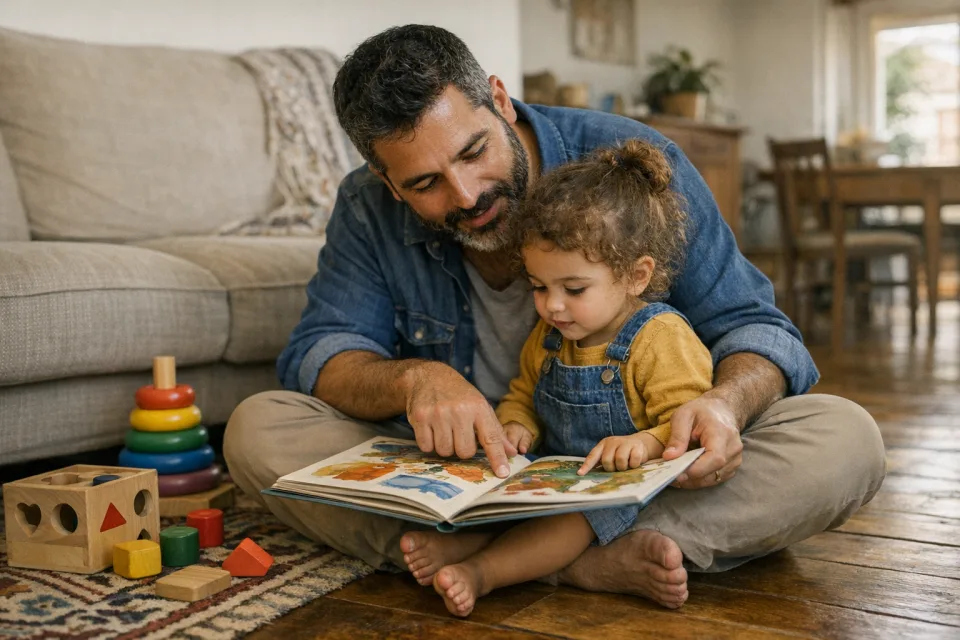
Pointing, showing and linking words to concrete objects helps a lot. Reading picture books, naming people and toys, and using supportive gestures all make understanding and expression easier.
Repeat and expand on what your child says
If your child says “water”, you might reply “Do you want water?” or “Yes, here is the water”. If they say “car”, you can expand: “It’s the red car.” This helps them hear a slightly richer version of their own speech.
Read every day
Shared reading supports vocabulary, attention and understanding. You do not need long texts. Simple picture books and questions like “Where is the dog?” or “What do you think will happen?” are excellent.
Play in interactive ways
Games like hiding objects, making animal sounds, building with blocks, pretend play or singing songs with gestures encourage spontaneous communication.
Reduce passive screen time
Screens do not replace human interaction. To develop language, children need to hear, respond, look, imitate and take turns in communication. If screen time is used, it is best kept moderate and accompanied by an adult.
Create predictable routines
Routines help children anticipate what comes next and make it easier to learn everyday words: bath, eating, tidying up, leaving the house, bedtime.
What to avoid
Some well-meaning actions can make communication harder:
- Pressuring the child to repeat words all the time.
- Criticising pronunciation repeatedly.
- Comparing them with siblings or other children.
- Asking too many questions without giving time to answer.
- Using screens as the main way to entertain or calm them.
The goal is to help without turning speech into a source of stress. Communication improves more when the child feels safe, listened to and encouraged.
When to seek help as early as possible
Seek assessment if your child:
- Does not react to sounds or to their name.
- Is not developing language as expected for their age.
- Loses skills they already had.
- Has difficulty understanding language.
- Shows little interest in interacting.
- Becomes very frustrated because they cannot communicate.
If hearing loss is suspected, assessment should be prompt. Hearing well is essential for learning to speak.
What if it is just a “late talker”?
Some children are called “late talkers”, meaning they start speaking later but eventually catch up well, especially when they understand language, play and interact appropriately. Even so, it is not a good idea to wait passively. Monitoring progress and, if needed, starting intervention helps prevent later difficulties, especially with reading and writing.
How to support without losing confidence
It is natural for parents to worry. But most children benefit greatly from early intervention and a responsive family environment. The most important thing is to observe, ask for help when needed and keep a calm, consistent approach.
Speaking later does not define a child’s intelligence or their worth. Often, with the right assessment, small changes in daily routines make a big difference.
Conclusion
Speech delay can have several causes and different levels of severity. The key is not to ignore persistent signs, especially if there are concerns about hearing, understanding or interaction. With early assessment and support at home, many children make very positive progress.
If you suspect speech delay, speak with your paediatrician, ask for guidance and start strengthening communication in your daily routines now. The earlier a child is supported, the better.
Frequently asked questions
My child is 2 and speaks very little. Should I be worried?
Not all children develop at the same pace, but by age 2 it is usually important to check whether there are few words, limited understanding or difficulty combining two words. If you are unsure, speak with your paediatrician.
Do screens delay speech?
Excessive screen use, especially without interaction with an adult, can reduce opportunities for communication. Speech develops best through conversation, play and shared reading.
What does a speech and language therapist do?
They assess the child’s communication, understanding, articulation and language, and help define strategies to encourage speech and interaction.
Should I wait to see if it goes away on its own?
Some children do catch up naturally, but waiting too long can delay the support they need. If the signs persist, it is worth having an early assessment.