
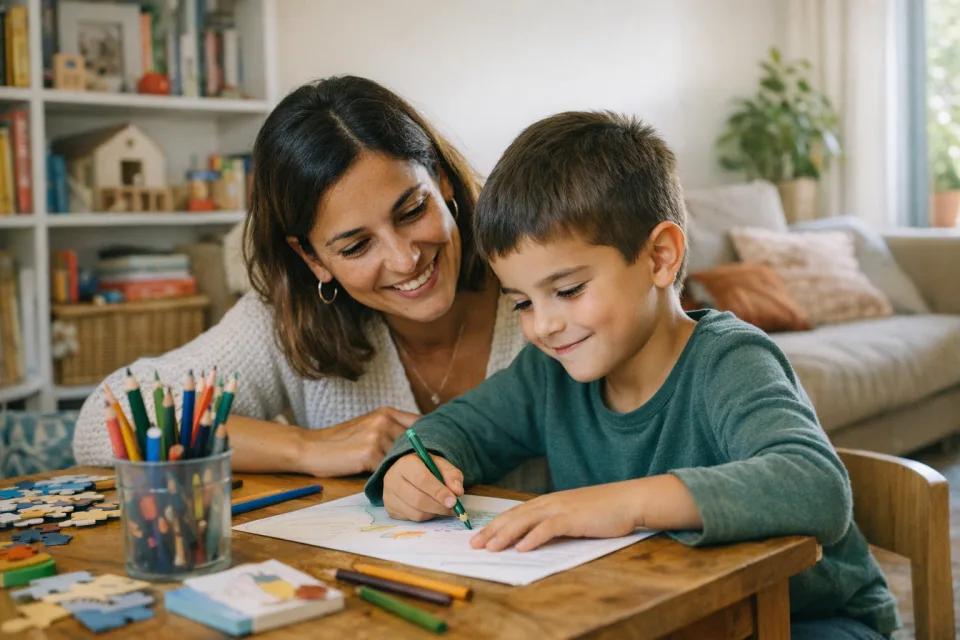
Children’s self-esteem does not come from constant praise or big speeches. It is built mainly in everyday life, through small interactions that send an important message: “You are capable, you matter, and you are loved even when you make mistakes.”
Many parents and caregivers want to help their children become more confident, but are unsure what to do in practice. How can you praise without overdoing it? How do you help when a child gives up easily? And how can you support them without doing everything for them?
The good news is that confidence grows at home, at school, and in close relationships through simple, consistent habits. The goal is not to raise children who are perfect or always self-assured. It is to help them build a steady emotional foundation so they can face challenges, frustration, and learning.
What is children’s self-esteem?
Self-esteem is how a child feels about themselves. It includes a sense of personal value, competence, and belonging. When self-esteem is stronger, a child is more likely to take risks, learn from mistakes, and ask for help when needed. When it is fragile, they may avoid challenges, compare themselves too much, become very sensitive to criticism, or give up quickly.
It is important to remember that all children have more confident days and more insecure days. That is normal. The aim is not to remove doubts, but to teach children how to cope with them without feeling less worthy because of them.
1. Confidence starts with the relationship
A child feels safer when they see that the adults around them are predictable, attentive, and respectful. Before they can truly “believe in themselves,” they need to feel: “There is someone who sees me, listens to me, and helps me.”
This means responding with presence, not just correction. Making eye contact, listening carefully, validating feelings, and keeping routines consistent are all ways of building emotional security.
For example, when a child gets frustrated because they could not finish a drawing or lost a game, instead of dismissing the feeling, you might say: “I can see that you’re sad. That was difficult for you. Shall we try again?”
This kind of response teaches that frustration is normal and that making mistakes does not destroy a child’s value.
2. Praise effort, not just results
One of the most effective ways to strengthen self-esteem is to value the process, not only the outcome. When children only hear “you’re so smart” or “you’re the best,” they may start to believe that they only have value when they get things right. That can create fear of failure.
It is more helpful to praise specific behaviours:
- “I liked how you kept trying.”
- “You prepared well for this.”
- “You were brave to have a go, even though you weren’t sure it would work.”
- “You managed to ask for help, and that matters too.”
This kind of praise shows children that effort, persistence, and courage count. They learn that growth is a process, not a test of perfection.
3. Let children do what they can on their own
Confidence also grows when children feel competent. For that, they need real opportunities to try things that are suitable for their age.
Setting the table, choosing clothes, tidying toys, preparing a school bag, pouring water, brushing their hair, or helping with small jobs at home are simple ways to build autonomy. When adults do everything for children to avoid delays, mess, or mistakes, they may unintentionally send the message that the child is not capable.
Of course, help is still needed. The difference is supporting without replacing them. Instead of doing it for the child, you can guide them:
“I’ll start it and you finish it.”
“Show me how you think you’ll do it.”
“Do you want to try first on your own while I stay here and watch?”
These small responsibilities help build competence and healthy pride.
4. Teach children to handle mistakes without shame
The way adults react to mistakes has a huge impact on self-esteem. If a child feels that making a mistake leads to criticism, shame, or comparison, they may learn to hide difficulties instead of facing them.
On the other hand, when mistakes are treated as part of learning, children feel free to try. A very useful message is: “Making mistakes does not mean you are incapable. Mistakes are part of learning.”
It can help to say:
- “Let’s see what did not go so well.”
- “What did you learn from this?”
- “What could be different next time?”
Avoid comparing children with siblings, classmates, or other children. Phrases like “look at your brother” or “your friend can do it” can damage confidence and increase feelings of inadequacy.
5. Respectful boundaries also strengthen self-esteem
It may sound contradictory, but clear boundaries help children feel secure. When they know what they can and cannot do, they understand that adults are guiding them. That brings emotional stability.
Boundaries should be firm but respectful. There is no need to humiliate, shout, or threaten a child in order for them to listen. It is possible to correct calmly and consistently:
“I won’t let you hit.”
“I can see you’re angry, but you cannot throw things.”
“It’s time to turn off the screen now. We’ll talk again after.”
When boundaries are predictable, children feel the world around them is safer. And safety is one of the foundations of self-esteem.
6. Help children name their emotions
Children who can recognise and name what they feel find it easier to regulate emotions and communicate needs. This also strengthens confidence, because they stop feeling “bad” simply for being sad, angry, or scared.
You can use simple phrases such as:
- “You’re frustrated because you wanted to keep playing.”
- “It looks like you felt embarrassed.”
- “You’re nervous about the presentation.”
Naming emotions does not mean giving in to everything. It means showing understanding while keeping the boundary in place. Children learn that feelings are acceptable, but not all behaviours are.
7. Create moments of one-to-one attention
It does not always take much time. Sometimes ten minutes of full attention are worth more than an hour with a distracted adult. When a child feels there is space to be listened to without rushing, the bond grows stronger and so does their sense of value.
These can be small moments: playing, talking at bedtime, reading a story, cooking together, walking to school, or simply listening to what happened during the day.
If there is more than one child, try to make time for each one individually, even if only briefly. Every child needs to feel they are not just “one more” person in the family.
8. Be mindful of the impact of words at home
Adults’ words stay in children’s memory much longer than we often realise. Repeated comments such as “you’re always messy,” “you’re lazy,” or “you never do anything right” can become internal labels.
Instead of labelling the child, focus on the behaviour and the solution:
“Today you didn’t tidy away the toys.”
“That was done in a hurry.”
“Let’s try another strategy.”
That difference matters. The child stops feeling that the problem is their identity and begins to see that they can learn, change, and improve.
9. Support self-esteem without pressure to be “always strong”
Some adults, with the best intentions, give children the idea that they should always be confident, always brave, or always happy. But that is neither realistic nor healthy. Children also need to learn to ask for help, show vulnerability, and accept that some days are hard.
Healthy self-esteem is not arrogance or perfectionism. It is balance. It means knowing: “I have value, even when I cannot do everything.”
It is also wise to avoid excessive praise that feels insincere to the child. The most important thing is to be genuine, specific, and consistent.
10. The role of school, friends, and screens
Self-esteem is also shaped by life outside the home. At school, a child may feel capable or undervalued. Among peers, they may gain confidence or feel more insecure. And screen use can increase comparison, especially when children are exposed to unrealistic images and content that emphasises appearance, popularity, or performance.
It is worth keeping an eye on what children see, talk about, and share online, especially in the later primary years and adolescence. This is not about controlling everything, but about keeping an open conversation about self-esteem, comparison, and social pressure.
If a child says they “are worth nothing,” that “others are always better,” or that “nobody likes me,” it is important to listen seriously. These phrases can be signs of emotional distress and deserve attention.
Signs that self-esteem may need extra support
Some children show stronger signs of insecurity. It may be helpful to seek professional support if you notice:
- an excessive fear of making mistakes;
- frequent giving up before even trying;
- constant crying or irritability over small difficulties;
- repeated negative comparison with themselves;
- social withdrawal;
- frequent complaints of not being loved or capable;
- a marked drop in interest in school or activities.
If these signs persist, speaking with a paediatrician, the school, or a child psychologist can help clarify what is going on.
A simple idea to try this week
Choose one small daily routine to help strengthen your child’s confidence. It could be a task they do on their own, a conversation at dinner, or a more specific encouraging phrase at the end of the day.
For example, every night you could ask:
“What made you proud today?”
“What was difficult, and how did you deal with it?”
“What did you try, even when you did not feel like it?”
Over time, these questions help children look at themselves with more clarity, more kindness, and more confidence.
In summary
Children’s self-esteem is built through presence, boundaries, respect, autonomy, and words that create safety. It does not depend on perfection or constant praise. It depends on repeated experiences in which the child feels capable, can make mistakes without losing value, and has an attentive adult by their side.
Building confidence in everyday life is quiet work, but powerful. It begins with simple gestures: listening, encouraging, guiding, and believing in the child while they learn to believe in themselves.