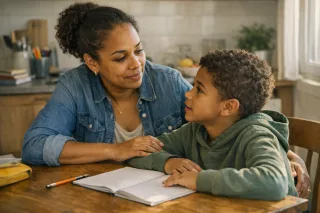

A child who feels ashamed of their body may start avoiding changing clothes in front of others, refuse to go to the pool, compare themselves with classmates, or make negative comments about their own body. Sometimes the shame shows up in subtle ways. Other times, the child says it plainly: “I’m fat,” “I’m ugly,” “I don’t like my legs,” “I want to hide my belly.”
For parents and caregivers, this can be hard to hear. The instinct is often to push back right away, saying “that’s not true” or “don’t be silly.” But talking about body image requires more listening and less rushing. A child needs to feel that their discomfort is taken seriously, without being mocked or made to feel dramatic.
This topic matters because the way a child learns to see their body affects self-esteem, their relationship with food, social confidence, and even mental health as they grow. In Portugal, as elsewhere, appearance pressure starts early: comments from relatives, images on social media, jokes at school, and constant comparison can all leave a mark.
What body image is
Body image is the way a child perceives, thinks about, and feels about their own body. It does not depend only on physical appearance. It also includes emotions, experiences, comments they have heard, and the environment around them.
A child can have a healthy body and still feel ashamed of it. They may be within what is considered a typical weight range and still believe they “have the wrong body.” That happens because body image is shaped by what children see, hear, and learn about beauty, worth, and acceptance.
In childhood and adolescence, the body changes a lot. Growth, puberty, breast development, body hair, acne, weight gain or redistribution, and differences in timing compared with classmates can all create insecurity. In some cases, body shame is linked to bullying, family comments, rejection, early puberty, chronic illness, or special needs.
Signs a child may feel ashamed of their body
Children do not always say directly what they feel. These are some signs to look out for:
- Avoids changing clothes at school, in sports, or in group activities
- Refuses to wear tighter clothes, swimsuits, or gym clothes
- Spends a lot of time in front of the mirror or, on the contrary, avoids looking at themselves
- Makes repeated comments about being “ugly,” “fat,” “weird,” or “too thin”
- Compares themselves with siblings, classmates, or people on social media
- Gets very upset about photos, videos, or parties
- Starts hiding their body in loose clothes even when there is no need
- Feels anxious before going to the beach, the pool, or PE class
- Changes eating habits because of shame or concern about weight
Some of these signs can be normal at certain stages of development. What matters is the frequency, intensity, and impact on the child’s daily life.
How to talk without increasing shame
The goal is not to force the child to agree that “everything is fine.” The goal is to help them feel safe, understood, and respected.
Start by listening. If a child says, “I don’t like my body,” you might answer: “I can hear that this is really bothering you. Do you want to tell me what makes you feel that way?” Instead of minimising it, name the emotion: “You seem sad,” “Are you feeling ashamed?”, “This must be hard for you.”
Avoid turning the conversation into an argument about whether they are “pretty” or not. The most helpful approach is to talk about the body as something that deserves care, not judgment. You can say: “Your body doesn’t have to be perfect to be valuable” or “Your worth doesn’t depend on the size of your clothes.”
It also helps to remind children that the body does important things: running, playing, learning, hugging, sleeping, breathing, growing. This shifts attention away from appearance and toward a more respectful, practical relationship with the body.
What to say and what to avoid
Helpful things to say:
- “Thank you for telling me”
- “You’re not alone”
- “We can talk about what makes you feel this way”
- “Your body is growing and changing, and that’s normal”
- “There is no one right body for playing, learning, or being loved”
- “Let’s find ways to help you feel more comfortable”
Better to avoid:
- “You’re overreacting”
- “Don’t say that, you’re beautiful” said too quickly, without really listening
- “If you lost weight, you’d look better”
- “Your sister is prettier”
- “Don’t be upset about a little extra fat”
- Constant critical comments about your own body
Seemingly harmless phrases can be understood by a child as confirmation that the body is a problem to be fixed. The tone of the conversation matters as much as the words.
The role of parents: the example starts at home
Many children learn how to look at their bodies through the adults around them. If a home is full of talk about diets, weight, food guilt, “bad” fats, or physical flaws, a child may conclude that a person’s value depends on appearance.
It is worth noticing how adults speak about themselves. Comments like “I look terrible,” “I’m too fat for this,” or “I need to lose weight right now” may seem harmless, but they build a culture of body dissatisfaction.
Instead, try to model care. For example, “I don’t feel comfortable in this outfit today” is different from “my body is wrong.” Teaching the difference between comfort, health, and appearance helps children think more clearly.
It is also important to avoid praise based only on beauty. When children hear mainly that they are “pretty,” they may feel pressure to meet a certain standard. It is healthier to value qualities like kindness, courage, effort, creativity, persistence, and a sense of humour.
Conversations by age
With younger children, keep the approach simple. Talk about body differences as normal. Explain that people grow at different speeds, that there are tall, short, thin, strong bodies, bodies with scars, glasses, different hair, and that all of them deserve respect.
At primary school age, comparison with classmates becomes more common. This is a good time to talk about advertising, filters, edited images, and the fact that not everything on a screen reflects reality. Children need help understanding that many images are chosen, edited, and presented to look perfect.
In adolescence, body shame can intensify because of puberty and social pressure. At this stage, privacy matters. Listen without intruding and stay available. A teenager may not want long talks, but they need to know they can return to the topic whenever they want.
When school and peers play a role
School can be a place of protection or of pain. Comments about the body, cruel jokes, comparisons in PE, or rumours on social media can increase body shame.
If there are signs of bullying, it is important to act early. Talk to the child, the school, and, if needed, the school support services. In Portugal, schools have mechanisms in place to address violence between peers. Staying silent usually prolongs the problem.
It also helps to teach children how to respond to inappropriate comments. For example: “I don’t like you talking about my body like that,” “That comment hurts me,” or “My body is not a joke.” Being able to set boundaries is part of self-esteem.
Body image, food, and exercise
Body shame can lead to unhealthy eating behaviours. Some children start eating in secret, skipping meals, feeling guilty about eating, or trying to “compensate” with excessive exercise. Others stop moving because they feel exposed.
For that reason, it is important to clearly separate food from morality. Food should not be treated as a reward, punishment, or source of shame. Talking about balance, hunger, fullness, energy, and variety is much more useful than talking about “good” food and “bad” food.
With exercise, the focus should be on enjoyment, health, and what the body can do, not punishment. Playing, dancing, swimming, walking, cycling, or doing sports can help a child experience the body as an ally rather than an enemy.
When to seek professional help
Seek support if body shame is affecting the child’s daily life, for example if they:
- Avoid leaving the house or taking part in activities
- Cry often because of their body
- Show intense anxiety about clothes, bathing, or mirrors
- Have concerning changes in eating habits
- Speak about themselves with deep contempt or guilt
- Show signs of depression, isolation, or self-harm
- Are being bullied repeatedly
In these cases, a paediatrician, family doctor, child psychologist, or child and adolescent psychiatrist can help figure out what is happening and define a support plan. The earlier it is addressed, the easier it is usually to rebuild confidence and self-esteem.
How to build a healthier family culture
Prevention starts with everyday routines. A home where people speak respectfully about the body, food, and differences gives children a safer foundation.
Some practical ideas:
- Avoid comments about your children’s bodies in front of other people
- Do not compare siblings or cousins with one another
- Choose books, films, and shows with body diversity
- Teach that different people can have value, ability, and their own kind of beauty
- Value the body for what it does, not only for how it looks
- Talk about health in a balanced way, without obsession
- Show that asking for help is a sign of strength, not weakness
If your family has faith practices or spiritual values, you can also reinforce the idea of dignity, care, and respect for the body as part of the person. In many families, this helps children feel more accepted and less judged.
In the end
When a child feels ashamed of their body, they do not need lectures or ready-made phrases. They need adults who can listen, validate, and guide. Talking about body image at home is a way to protect self-esteem and teach that a person’s value can never be measured by a mirror.
If the topic comes up, do not avoid it. A calm, repeated, respectful conversation can do more for a child than any attempt to quickly convince them that they are “beautiful.” The goal is not for them to love their body every day. It is for them to learn to treat it with less harshness and more care.
Related reading
For more support, you can also look at trusted resources such as SNS 24, the Directorate-General of Health, APAV, and UNICEF Portugal.