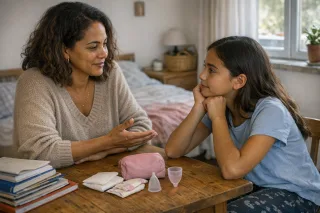

Why it is important to talk before the first period
The first period can happen unexpectedly, but it does not have to feel like a surprise. Talking about it naturally beforehand helps reduce fear, embarrassment, and confusion. When a daughter already knows what to expect, she is more likely to feel safe if she notices blood in her underwear, on toilet paper, or on a wipe after using the bathroom.
More than explaining a change in the body, this is a moment to share a simple message: menstruating is normal, it is part of growing up, and it does not make anyone less than they are. If the conversation feels calm, a child or teenager is more likely to ask questions without feeling judged.
There is no exact age to start. In general, it is worth talking before puberty advances too far, especially if the girl is already noticing signs such as breast development, pubic hair, vaginal discharge, or mood changes. The more natural the conversation is, the less heavy it becomes.
How to start the conversation without making it awkward
The key is to treat it like any other health or growing-up topic. You can begin with an everyday situation: a TV ad, a school conversation, a pharmacy visit, or even a comment about menstrual products.
Simple phrases help:
“Girls’ bodies change when puberty starts.”
“One of those changes is menstruation, and it is normal.”
“If you want, I can explain how it happens and what to do when it comes.”
If your daughter feels embarrassed, do not force a long talk. You can say you are available whenever she wants to talk. Often, a short and open conversation is better than a very detailed explanation at a time when she is not ready.
It also helps to use the correct names for body parts and avoid childish terms or euphemisms that make the topic feel secret. The message should be clear, respectful, and calm.
What your daughter needs to know about menstruation
Preparation does not have to be complicated. The essential points are:
Menstruation is blood loss through the vagina that happens because the body is becoming fertile.
It is normal to start between ages 9 and 15, although this can vary.
In the first years, the cycle may be irregular.
There may be mild cramps, bloating, tiredness, or mood changes.
There are products to absorb blood, such as pads and tampons, and each family can decide what feels right to use.
It is helpful to explain that the first period may be light or heavier, last a few days, and in some cases may not become regular right away during the first months. This avoids unnecessary worry.
It is also important to say that menstruation is not dirt, punishment, or illness. It is a natural body function. Speaking this way can make a big difference in self-esteem and in the relationship a girl builds with her own body.
How to prepare a discreet kit for school or going out
Having a small kit can give your daughter confidence. It can be a discreet pouch with:
2 to 3 pads
an extra pair of underwear
a small bag for dirty clothes
unscented wipes, if needed
one extra dark piece of clothing, if it makes sense
If she already goes to school, agree on a simple plan: where to keep the kit, who she can talk to if she needs help, and what to do if her period starts away from home. Teach her to identify the school bathroom, the school nurse, the tutor/class teacher, or another trusted adult when available.
Having pads at home and in her backpack reduces anxiety. This is not about expecting problems, but about offering safety and independence.
How to choose menstrual products for the first time
For a first period, many families choose pads because they are easier to use and give the girl time to get used to the flow. There are different sizes and thicknesses, and it may help to start with smaller, more discreet options.
Tampons or menstrual cups may be options later on, if the girl feels comfortable and the family thinks they are appropriate. There is no rush. What matters most is that she feels safe and knows how to insert, change, and dispose of the product properly.
Also explain how often to change the pad and the importance of hygiene: wash hands before and after, change the product when it is full or at regular intervals, and keep the genital area clean without over-washing or using scented products.
What to do if the first period happens by surprise
If the period starts and your daughter gets scared, your reaction matters a lot. Try to stay calm. If the adult becomes nervous, the child is more likely to feel that something is wrong.
You can say something like:
“It’s okay, this is your first period. I’ll help you.”
Then help her go to the bathroom, clean up, put on a pad, and change clothes if needed. If you are out, improvise with whatever is available while heading home or back to school. The most important thing is to show calm and support.
Avoid jokes, acting shocked, or telling other people without permission. For many girls, this moment is very private and can feel embarrassing.
How to handle fear, embarrassment, or refusal to talk
Not every girl will accept the topic right away. Some feel embarrassed, others laugh to hide it, or say they do not want to know. That does not mean the conversation was wrong. It may simply mean they need time.
If you notice resistance, try to respect her pace. Do not force it. Offer information gradually and say you can return to the topic whenever she wants. Trust is built better this way than through persistence.
It is also important to validate feelings. You can say, “It’s normal to find it strange” or “Many girls feel that way at first.” When a child realizes she is not alone, the fear usually becomes smaller.
If there is very strong anxiety, extreme embarrassment, or ongoing refusal to deal with the body and hygiene, it may be helpful to speak with the paediatrician or family doctor. In some cases, the way puberty is being experienced benefits from extra support.
The role of the father, mother, and other caregivers
The conversation about menstruation should not be left only to the mother. Fathers, stepfathers, grandparents, and other caregivers can and should know how to talk about it respectfully. This helps avoid the idea that menstruation is a forbidden topic between adults and girls.
If the father feels unsure about bringing it up, he can start simply and calmly: show that he is available to help, buy products if needed, and treat the subject without embarrassment. For a daughter, feeling supported by trusted adults makes a difference.
When there are siblings at home, it can be helpful to talk about puberty changes in an age-appropriate way, so the topic becomes normal in the family and teasing or disrespectful comments are avoided.
When to seek medical advice
In most cases, a first period does not require concern. Still, there are signs that should be discussed with a healthcare professional:
periods before age 8
no period after age 15, especially if other puberty signs are already present
very heavy bleeding
severe pain that prevents normal activities
dizziness, weakness, or frequent paleness
very irregular cycles for a long time
If a teenager has questions about discharge, hygiene, pain, or menstrual products, the family doctor, paediatrician, or a youth health appointment can help. In Portugal, follow-up may also happen in primary healthcare and, when needed, in hospital specialties.
When the topic is sensitive, your daughter needs to feel that asking for help is normal. The goal is not to alarm her, but to make sure she gets support when something is not as expected.
How to turn this moment into a conversation about self-care
The first period can be a good starting point for talking about body care, self-esteem, and privacy. You can take the opportunity to remind her that she has the right to respect, correct information, and help when she needs it.
You can also talk about habits that help during menstruation: drinking water, resting when needed, keeping a balanced diet, and wearing comfortable clothes. If there are cramps, local heat and rest can help in some cases; if the pain is significant, it should be assessed by a professional.
This is also a moment to reinforce values of respect and dignity. Some families like to experience this stage with a broader sense of growth, gratitude for the body, and personal care. When done sensitively, this can help a girl feel that she is entering a new stage of life with support and meaning.
Conclusion
Preparing your daughter for her first period naturally is, above all, about being available, informing without drama, and welcoming without shame. The sooner the topic becomes part of family conversation, the easier it will be to live through this change with calm and confidence.
The conversation does not need to be perfect. It just needs to be honest, respectful, and open. With a simple explanation, a prepared kit, and a supportive adult, the first period stops being a shock and becomes just another normal step in growing up.
Frequently asked questions
At what age should I talk about periods?
Ideally before they start, preferably when puberty has already begun to show signs. Many families start talking between ages 8 and 10, adjusting the conversation to their daughter’s maturity.
Should I show pads before the first period?
Yes, it can be helpful. Showing a pad and explaining what it is for helps a child recognise the product and feel prepared if she needs to use it.
Is the first period always very painful?
No. Some girls feel only mild discomfort, while others have light cramps. Very strong or disabling pain should be assessed by a healthcare professional.
Is it normal for the cycle to be irregular at first?
Yes. In the first months or years, the cycle can vary quite a lot. That is part of the body adjusting, although there are signs that do need medical assessment.
Should the father also talk about this?
Yes. Menstruation is a health and growing-up topic, not just a conversation between women. When a father talks about it naturally, it helps normalise the subject and strengthens family support.