
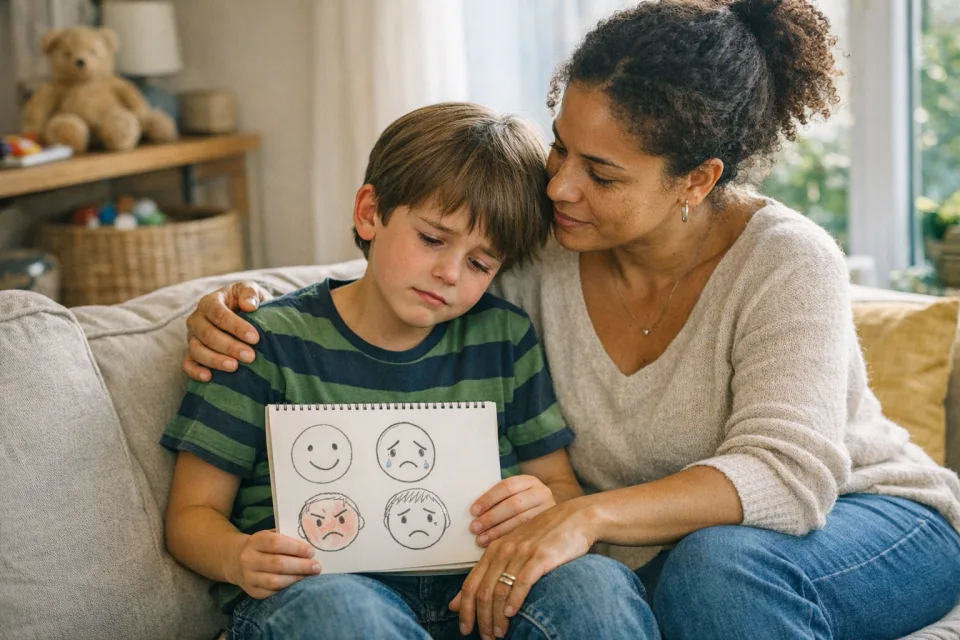
When sensitivity is both a strength and a challenge
Some children cry easily, react strongly to a change of plans, are deeply affected by a harsh comment, or seem to absorb the mood around them. These are highly sensitive children. Parents often wonder whether this is normal, whether they are overprotecting too much, or whether the child is simply “fragile.”
Sensitivity, by itself, is not a problem. It can come with empathy, attention to detail, creativity, and a strong ability to notice other people’s emotional state. The key is not to “harden” the child, but to help them recognize what they feel, tolerate frustration, and develop the resources to cope with the world without feeling overwhelmed by it.
Supporting emotions does not mean removing limits, avoiding challenges, or solving everything for the child. It means showing: “I see what you’re feeling, and I’m with you while you learn to get through it.”
What characterizes a highly sensitive child?
Not all sensitive children are the same. Some react more to noise, others to uncomfortable clothing, criticism, separations, unfairness, or changes in routine. In general, a highly sensitive child may:
- cry or become upset easily over small frustrations;
- take longer to recover after a conflict;
- feel deeply affected by comments, even neutral ones;
- worry excessively about mistakes or assessments;
- become overwhelmed in highly stimulating environments;
- pick up quickly on adults’ moods;
- avoid new situations for fear of failing or feeling exposed.
It’s important to remember that sensitivity is not the same as lack of strength. Many sensitive children feel intensely because their emotional system reacts very quickly. What they need is support to regulate that intensity, not shame for feeling it.
The difference between validating and overprotecting
One of the biggest challenges for parents is finding the balance between comforting a child and not reinforcing the idea that they are incapable. Validating an emotion does not mean agreeing with every reaction. It means recognizing the child’s experience without judgment.
Examples of validation:
- “I can see you were really sad when the game ended.”
- “That was hard for you, and it makes sense that you’re upset.”
- “You will feel better. Let’s breathe and think about the next step.”
Overprotection, on the other hand, happens when the adult tries to avoid any discomfort, removes all challenges, lowers expectations all the time, or sends the message that the world is too hard for the child. The intention is to protect, but the effect can be to limit the child’s confidence in themselves.
A child grows when they feel supported and also when they discover, with help, that they can handle small doses of frustration, fear, or disappointment.
How to support without making them feel fragile
1. Put words to what the child is feeling
Children often feel more than they can explain. Helping them name emotions is an essential step in emotional regulation.
You can say:
- “You seem frustrated.”
- “You’re disappointed because you expected something different.”
- “It looks like you felt embarrassed.”
When an adult gives language to what is happening inside, the child learns that what they feel can be understood and, little by little, organized.
2. Separate emotion from behavior
It’s important to accept the emotion without accepting any behavior. A child may feel anger, jealousy, fear, or sadness, but that does not give them permission to hit, insult, or destroy things.
A useful phrase is: “You can be angry, but you cannot hit.” In this way, the emotion is accepted and the boundary remains in place.
This separation is very protective because it teaches that feeling intensely does not mean losing control or being excused for any action.
3. Keep routines predictable
Sensitive children often benefit from predictability. Knowing what comes next reduces anxiety and helps them feel safer.
Small gestures make a difference:
- give a warning before transitions;
- explain changes of plans in advance;
- keep schedules consistent whenever possible;
- use rituals to begin and end the day.
When routine is stable, the child spends less energy trying to anticipate the unexpected and can use more of that energy to explore, learn, and play.
4. Don’t rush the emotion
Phrases like “don’t cry,” “it’s nothing,” or “that’s over now” can make a child feel wrong for having feelings. Instead, the adult can stay present without forcing a quick fix.
For example:
- “You can cry. I’m here.”
- “Take the time you need to calm down.”
- “When you’re ready, we can talk about what happened.”
This teaches that discomfort is tolerable and that emotions have a beginning, middle, and end.
5. Teach concrete regulation strategies
A sensitive child needs practical tools, not only explanations. Some simple strategies include:
- taking a few deep breaths;
- a tight hug, if the child likes that;
- drinking water slowly;
- going to a calmer space;
- drawing what they felt;
- using words to ask for help.
The goal is not to eliminate the emotion, but to lower its intensity so the child can think more clearly again.
6. Model calm without pretending to be perfect
Children learn a great deal by watching adults. If parents can name what they feel and show respectful ways of dealing with frustration, the child gets a realistic example to follow.
You can say:
- “I’m annoyed, so I’m going to breathe before I answer.”
- “I felt disappointed, but I’ll try again.”
You do not need to seem calm all the time. It is more helpful to show how you recover after a difficult moment.
What to avoid in everyday life
Some approaches, even if well-intentioned, can make a child more insecure or more dependent on external approval.
Whenever possible, avoid:
- mocking the child’s reaction;
- comparing them with siblings or classmates;
- labeling them as “dramatic,” “a crybaby,” or “weak”;
- immediately solving any discomfort;
- sending the message that making mistakes is a disaster;
- overprotecting them from every challenge.
These messages can make a child believe that feeling deeply is a flaw. Over time, they may begin to hide emotions instead of learning how to regulate them.
How to help build resilience
Resilience is not the absence of feeling. It is being able to move through difficulties without losing connection with yourself, with others, or with reality. A sensitive child can become very resilient if they have adults who help them experience effort in a safe way.
To do this, it helps to:
- offer small, manageable challenges;
- praise effort, not just results;
- normalize trying and making mistakes;
- show that disappointment can be tolerated;
- allow the child to try again after failing.
Instead of saying “it’s okay,” it is often better to say “that was really hard, and you still managed to keep going.” That message builds much more strength.
What if the sensitivity seems excessive?
There are situations in which emotional intensity may need extra attention. It is worth watching for signs that the child:
- regularly avoids school, parties, or activities because of intense fear;
- has frequent, prolonged meltdowns that greatly interfere with daily life;
- has recurring physical complaints linked to anxiety, such as stomachaches or headaches;
- shows persistent distress, sadness, or irritability;
- has difficulty sleeping, eating, or separating from parents for long periods.
In those cases, it may help to speak with a pediatrician, family doctor, or child psychologist. In Portugal, the school can also be an important ally in understanding what is happening in the child’s day-to-day context.
Asking for help is not a sign of failure. On the contrary: the earlier a child is supported, the easier it is usually to help them build emotional security.
The role of family and environment
A highly sensitive child does not live only inside themselves. The family climate, the level of conflict at home, adult exhaustion, constant rushing, and lack of predictability can greatly increase their reactivity.
Calmer environments, with clear rules and consistent affection, tend to help. It is also important to respect the child’s temperament without defining them by it. They are not “the sensitive one” as a fixed identity. They are a whole child, with strengths, fears, interests, and the ability to grow.
Helpful words
Some phrases can make a big difference in how a child sees themselves:
- “You’re a child who feels deeply, and that is not a flaw.”
- “I’ll help you deal with this.”
- “You can feel afraid and still keep going.”
- “You don’t have to hide what you feel for me to love you.”
- “We trust you to learn how to handle things little by little.”
These messages combine affection and firmness. That combination is exactly what protects.
In summary
A highly sensitive child needs understanding, not hardening. Supporting emotions without making them feel fragile means validating what they feel, keeping boundaries, teaching regulation strategies, and offering gradual opportunities to face discomfort.
When adults respond with presence, predictability, and respect, the child learns two essential things: that emotions are valid and that they are capable of getting through them. That repeated experience builds security, self-esteem, and resilience.
Being sensitive is not being weak. It can be, instead, the beginning of great emotional strength, as long as there are adults able to accompany the journey with balance.
Frequently asked questions
If your child is highly sensitive, these answers may help clarify common doubts.
Should I prevent my child from experiencing frustration?
No. Small frustrations that are appropriate for the child’s age help them develop tolerance for discomfort. The ideal is not to expose them to situations that are too demanding without support, but also not to remove every challenge.
Does crying a lot mean a child is weak?
No. Crying is a normal form of emotional expression. What matters is whether the child can, with help, recover and learn to deal with what they felt.
How can I calm them without giving in to everything?
Start by validating the emotion, keep the boundary, and offer concrete help. For example: “I know you wanted to keep playing. It’s time to leave now, and I’ll help you pack up.”
When should I seek professional help?
If the sensitivity causes very intense distress, school or activity avoidance, frequent crises, or ongoing difficulties in daily life, it is advisable to speak with a health professional.
Useful reading
For more information on child development, behavior, and emotional health, you can consult official and reliable resources.