Is it normal for siblings to fight?
Yes. In many families, disagreements between siblings are part of growing up. Rivalry, jealousy, competition for attention, age differences, and different temperaments can lead to conflicts almost every day. That does not, by itself, mean something is wrong in the family or with the children.
In fact, arguing can also be a way of learning. With siblings, children practise important skills such as negotiating, defending their point of view, compromising, repairing mistakes, and dealing with frustration. The problem is not that conflict exists. The problem is when fights become frequent, intense, frightening, or unfair to one child.
So the question should not only be “how do we stop the fights?” but also “when is it better to intervene, and when does it make sense to let them sort it out?”
When it is better to let them work it out
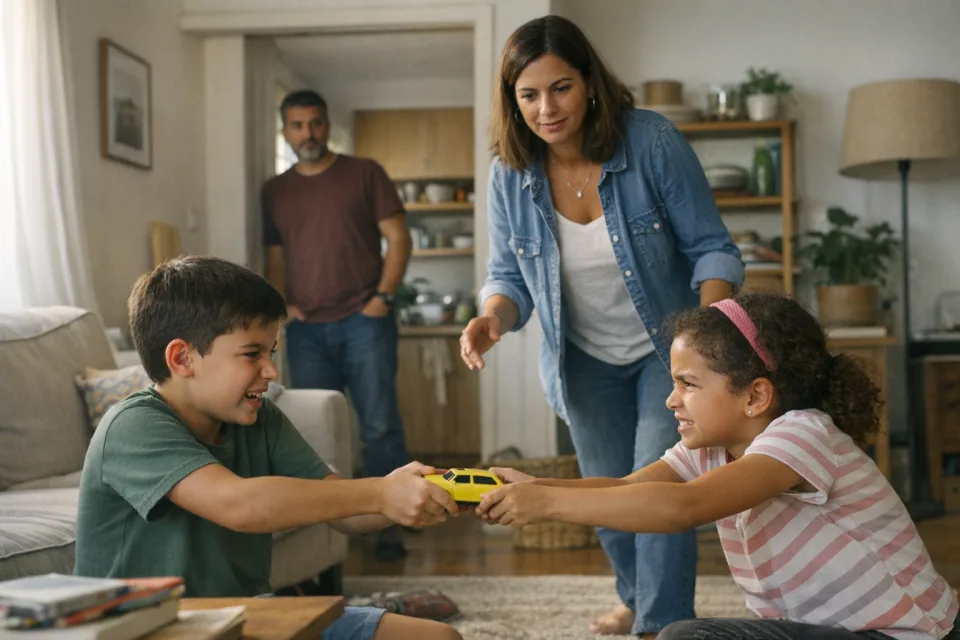
Not every argument needs an adult to step in right away. In many cases, intervening too early can stop siblings from learning how to solve small disputes on their own.
It can help to step back when:
- the argument is verbal and there is no physical aggression;
- the children can listen to each other without much fear or humiliation;
- the problem is small, such as a toy, a place on the sofa, or who gets to choose the game;
- there is room for each child to speak and try to find a solution;
- the tension settles on its own after a few minutes.
In these situations, observe from a distance. Often, it is enough to be available and attentive without immediately acting as judge. You can say something simple like: “I’m staying nearby. If you can’t solve it, I’ll help.”
This approach builds confidence. It shows children that they are capable of negotiating, without making them feel the adult will decide everything for them.
When you should intervene
There are times when letting children “sort it out” is neither safe nor helpful. Step in firmly when there are signs that the situation has gone beyond a normal conflict.
You should intervene if:
- there is physical aggression, such as pushing, biting, kicking, hitting, or using objects;
- one sibling is scared, crying and unable to stop, or asking for help;
- there are serious insults, humiliation, threats, or repeated cruel language;
- one sibling is much older, stronger, or using that advantage unfairly;
- the fight is escalating quickly and there is no longer any chance of dialogue;
- one child has special needs, greater emotional vulnerability, or difficulty defending themselves;
- the conflict is happening in a risky place, such as near stairs, the kitchen, the road, or other dangers.
You should also act when you notice the same pattern repeating and one child is constantly left distressed. Frequent fights are not only a problem because of the noise. Over time, they can affect self-esteem, emotional safety, and the sibling relationship.
How to intervene without making things worse
When you need to step in, the goal is not to find a culprit right away. First, you need to stop the escalation and make sure everyone is safe. Only then can you help them solve the problem.
Try these steps:
- Separate the siblings if needed. Speak calmly but firmly: “Stop. I won’t let you hurt each other.”
- Reduce the stimulation. If possible, take them to different spaces for a few minutes.
- Avoid long speeches in the heat of the moment. In a crisis, children hear very little. The more brief and clear you are, the better.
- Do not ask “who started it?” right away. That often turns into a battle over versions of events and increases tension.
- Acknowledge feelings without accepting aggression. You can say: “I understand you’re angry. Even so, you cannot hit.”
If the situation is very intense, the priority is calming things down before teaching anything. A child in full anger is not in the best state to learn a moral lesson in that moment.
After the fight: what to do
Once everyone is calm, that is the right time for a more useful conversation. This is when you can help siblings understand what happened and find better ways to act next time.
You can speak to each child separately, or together, in a simple way:
- what happened;
- how each child felt;
- what each child needed at that moment;
- what they could do differently next time.
Avoid turning the conversation into an interrogation or a long lecture. The goal is to teach skills, not to shame. If it makes sense, ask for a concrete repair: saying sorry, putting back something that was damaged, returning something taken away, or helping the hurt sibling.
It is important to remember that an apology alone does not solve everything. What matters most is the repair and learning what to do better.
What parents should avoid
There are common habits that can make sibling rivalry worse, even without meaning to.
Avoid:
- comparing children with each other;
- labelling one as “the aggressive one” and the other as “the angel”;
- always taking the same child’s side;
- solving everything for them without giving them room to practise negotiation;
- mocking jealousy, fears, or complaints;
- using phrases like “here you go again” or “you never get along”.
Parents’ words carry weight. When a child feels they are always the one to blame, or that their sibling is always the favourite, rivalry tends to grow. The same happens when adults reinforce the idea that fighting is “normal” and nothing needs to be done. The balance is in recognising conflict while still teaching clear limits.
How to reduce fights in everyday life
Intervening in the moment is important, but preventing conflict matters too. Small changes in family routine can reduce arguments a lot.
Some useful strategies:
- One-on-one time with each child. Even 10 to 15 minutes of exclusive attention can reduce jealousy.
- Clear house rules. For example: no hitting, no insulting, no taking things without asking, and ask for help when they cannot solve it themselves.
- Predictable routines. Hunger, tiredness, and too much stimulation make conflict much worse.
- Fair, not necessarily equal, treatment. Different children need different things. Fair does not always mean identical.
- Times when each child has their own space. Separating toys, materials, or areas of the home can avoid many disputes.
- Positive reinforcement. Notice and praise them when they manage to cooperate, share, or negotiate without escalating.
A home with siblings does not need to be quiet. But it can be a home where everyone learns to live together with respect.
What if the fighting seems constant?
If siblings fight every day, very intensely, or if one child is consistently sad, anxious, or withdrawn, it is worth looking more closely at the situation.
Ask yourself:
- is there a lot of competition for the parents’ attention?
- are there periods of extra family stress, such as a move, separation, bereavement, or school difficulties?
- is there a big age gap that requires closer supervision?
- are there signs of bullying at home?
- is one child taking out frustration from other areas of life?
If the dynamic feels too heavy, it may help to speak with your paediatrician, child psychologist, or school staff, especially if it is affecting sleep, appetite, school performance, or mood. In some cases, professional support helps uncover what is behind the conflict.
Different ages, different needs
What works for two siblings close in age may not work when one child is very young and the other is older. Younger children are still learning self-control. Older children may feel they have to “put up with it” or, on the other hand, use their age advantage unfairly.
If there is a big age gap, parents need to supervise more actively. It is not fair to expect a small child to sort things out alone with a much older sibling. The adult should protect the more vulnerable child and, at the same time, teach the older one to use strength, words, and patience responsibly.
When faith and values can help
For many families, sibling conflict is also an opportunity to teach values such as respect, truth, compassion, patience, and forgiveness. Whatever the family’s religion or beliefs, the central message is similar: siblings do not need to agree all the time, but they should learn to treat each other with dignity.
If faith is important in your family, you can use spiritual language in a simple, gentle way, without blame. For example, you might remind children that each child deserves care and that love at home also shows in the way people speak to each other and resolve conflict.
In summary
Siblings fighting is common and, in small doses, even part of development. Parents’ role is not to eliminate every conflict, but to decide wisely when to observe, when to mediate, and when to step in firmly.
Let them try to work things out when the conflict is small and safe. Intervene when there is aggression, fear, humiliation, or clear imbalance. Afterwards, help repair, talk, and find better strategies for next time. With consistent boundaries, respect, and practice, many siblings learn to turn rivalry into a stronger relationship.
If needed, start with one simple rule at home: “No hitting. No insulting. Ask for help when you cannot solve it.” Sometimes, that single starting point changes the tone of the whole home.